I've heard that baking soda and citric acid are good for cleaning drains, but you may be wondering which one to use first. In fact, if you do this in the wrong order, you won't get that fizzing foam at all, and the cleaning effect will be drastically reduced. In this article, we will explain the correct order and amount, and what to do if bubbles do not come out.
The correct order is "Baking soda first, then citric acid"
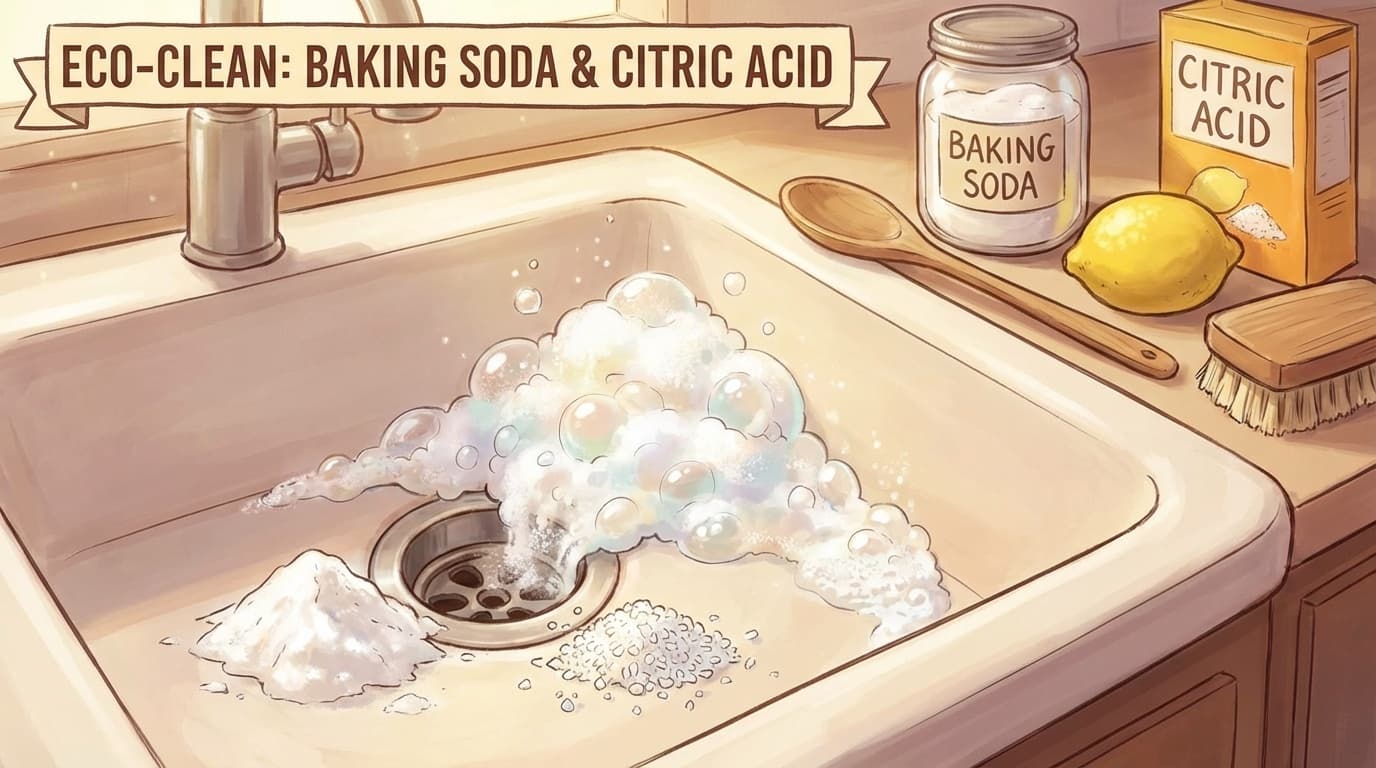
Let me start with the conclusion. The correct order is "Baking soda → citric acid → hot water". If you do the opposite, the effect will be halved, so be careful.
Click here for specific steps.
- Remove the drain cover and trash receptacle — First, remove the drain parts. Let's throw out the garbage that has accumulated in the garbage tray first
- Sprinkle baking soda evenly — Sprinkle baking soda in and around the drain. The recommended amount is 3 to 4 tablespoons (about 50g to 60g). Make sure to use enough so that it goes into the drain hole
- Pour the citric acid over the baking soda — Sprinkle the citric acid over the baking soda. The amount is 1 to 2 tablespoons (about 15g to 30g). A guideline is about half the amount of baking soda
- Pour hot water slowly — Slowly pour one cup (about 200ml) of hot water at about 40-50℃. Do not use boiling water (it may damage the drain pipe)
- Wait for bubbles to appear (leave for 5 to 30 minutes) — Once bubbles start to appear, leave it for 5 to 30 minutes. Bubbles lift away dirt
- Rinse with water — Finally, rinse with plenty of water and you're done
Baking soda comes first, followed by citric acid. Just remember this order and you'll be fine. It's also a good idea to memorize the words ``ju (baking soda) → ku (citric acid)'' = ``10 → 9''.
Why is order important? Scientific reason
You may think, "Isn't it the same no matter which one comes first?", but there is actually a good reason.
Baking soda (sodium bicarbonate) is alkaline, and citric acid is acidic. When these two react, carbon dioxide (CO2) bubbles are generated. The key to this cleaning method is that this foam physically lifts dirt from the drain and removes it.
Reasons for using baking soda first: By placing the baking soda in close contact with the drain first, bubbles will be generated efficiently on the surface of the drain when citric acid is added later. On the other hand, if you add the citric acid first, it will flow away as a liquid and the reaction with the baking soda will not occur properly.
Also, since baking soda itself has an abrasive effect, it has the effect of scraping away dirt stuck to the surface of the drain. By sprinkling baking soda first, you can take advantage of this polishing effect.
By the way, the foam itself does not have a strong cleaning effect. The purpose is to ``float'' dirt with the power of bubbles. For stubborn stains, consider using a commercially available pipe cleaner (such as Pipe Unish).
No bubbles! Causes and remedies
If you follow the steps but no bubbles come out...If that happens, please check the following.
Cause 1: The temperature of the hot water is too low
Reactions are difficult to occur with water. Use hot water between 40 and 50 degrees Celsius. However, boiling water over 60℃ is not allowed as it may deform the drain pipes (especially PVC pipes). Check the temperature setting on your water heater and prepare hot water at the appropriate temperature.
Cause 2: Too little amount of baking soda or citric acid
If you use too little, the reaction will be weak and hardly any bubbles will be produced. Make sure to use 3-4 tablespoons of baking soda and 1-2 tablespoons of citric acid. Baking soda and citric acid sold at 100 yen stores are sufficient.
Cause 3: Baking soda or citric acid is old or damp
If baking soda or citric acid is left for a long time after opening, it may absorb moisture and become less effective. If it is not in a smooth powder state, replace it with a new one. You can easily purchase it at Amazon or drugstore.
Cause 4: The drain is flooded with water
If the drain is soaked before you sprinkle the baking soda, the baking soda will dissolve in the water and drain. Lightly wipe off the moisture, then sprinkle with baking soda. It doesn't have to be completely dry, but it's best if there are no puddles.
Kitchen, bath, washstand, tips for each location
The tips for cleaning drains differ slightly depending on the location.
Kitchen drains
In kitchens with a lot of oil stains, baking soda and citric acid alone may not be enough. Sprinkling baking soda, then adding a few drops of dish detergent and then adding citric acid is also effective for removing oil stains. It can also be used to remove slime from garbage receptacles.
Bathroom drain
Hair and soap scum tend to accumulate in the bathtub. Before applying the baking soda + citric acid, first remove your hair. Even if you clean with hair still left, the effect will be halved. You can also use a drain hair catcher sold at 100 yen stores to prevent hair loss on a daily basis.
Wash basin drain
Since the space in the sink is small, you can use less baking soda and citric acid. 2 tablespoons of baking soda and 1 tablespoon of citric acid are enough. It is recommended that you clean it once a month, as toothpaste and soap scum tends to accumulate.
How often do you clean?
When cleaning the drain with baking soda + citric acid, use the following frequency as a guide.
- Kitchen:Ideally once a week. At least twice a month
- Bath:About twice a month. Ideally, remove hair every day
- Wash basin:Once a month is OK
If you do this regularly, you can prevent serious problems like clogged pipes. On the other hand, if you leave it for too long, you may end up with a level of dirt that baking soda + citric acid cannot compete with, so we recommend getting into the habit of it as soon as possible.
Frequently Asked Questions (FAQ)
Is it wrong to mix baking soda and citric acid before adding it?
It's not bad, but I don't recommend it. As soon as the two are mixed together, the reaction will begin and bubbles will form inside the container. Since you want the reaction to take place inside the drain, it is more effective to add them separately.
Can I use vinegar instead of citric acid?
You can use it! If you don't have citric acid, you can use table vinegar (grain vinegar) instead. After sprinkling baking soda, pour about half a cup of vinegar over it. However, vinegar may leave behind a smell, so be sure to rinse it thoroughly with water at the end.
Is baking soda and citric acid foam harmful to the body?
No. The bubbles generated are carbon dioxide, so there is no problem as long as you ventilate the area. There is no risk of "do not mix" like with chlorine-based detergents. It can be used safely even in homes with children and pets.
Can baking soda and citric acid unclog drain pipes?
It is effective for mild slime and dirt, but it is difficult when it is completely clogged. If the pipe is clogged to the point where no water can flow, consider using a specialized detergent such as Pipe Unish, or contacting a professional.
Does sesquicarbonate soda have the same effect?
Sodium sesquicarbonate is also slightly alkaline, so you can expect a similar effect, but baking soda produces more bubbles when it reacts with citric acid. Baking soda is recommended for cleaning suds from drains. Sesquish is more suited to cleaning oil stains.
References
- Basic knowledge of baking soda — Soap Encyclopedia
- Pipe Unish product information — Johnson
- How to use baking soda and citric acid — Living Nista