Have you noticed that the glass top of your IH cooking heater has brown burnt spots or oil rings stuck to it? Unlike a gas stove, it is flat and should be easy to clean, but the dirt left behind is surprisingly stubborn. Moreover, if you clean the glass incorrectly, it will scratch the glass surface and make it even more dirty.
In this article, we will explain the correct way to remove each type of dirt from an IH stove. We've put together a list of ways to safely make your hair sparkle using things you already have at home, such as baking soda, cream cleanser, and aluminum foil. Based on official information from each manufacturer as of March 2026.
There are three main types of dirt on IH stoves
Before you worry that the dirt won't come off, first find out what the dirt is on your IH. The detergent and approach you should use will vary depending on the type of stain.
1. Oil stains (yellow to brown stickiness)
Oil that has been splattered during stir-frying or deep-frying and has been burned by heating. It may be clear immediately after cooking, but if you leave it for a while, it will gradually turn brown and solidify. This is the most common stain on IH top plates.
2. Burnt stains (hard black to dark brown stains)
Stains are caused by boiling liquid boiling over from a pot or seasonings such as soy sauce or mirin baked onto the glass surface. Seasonings that contain sugar are particularly prone to caramelize and become hard, and are often difficult to remove just by rubbing.
3. Traces on the bottom of the pot (white to gray ring)
Dirt and metal components on the bottom of a pot or frying pan are transferred to the glass top by heating. Roughly speaking, it's a situation where the dirt from the pot has transferred to the IH side. This type also includes black marks from using aluminum pots.
Dirt type: Correct cleaning method
Once you know the type of dirt, use the appropriate method to clean it. Before cleaning, be sure to turn off the power to the IH and allow the top plate to cool down.
How to remove oil stains: Wipe quickly with a neutral detergent
Since oil stains are acidic, they can be removed with a neutral kitchen detergent. It is best to deal with it immediately after cooking.
- Put a few drops of mild kitchen detergent on a soft cloth or kitchen paper
- Gently wipe the oily area in a circular motion
- Wipe off with a cloth that has been thoroughly wrung out with water to avoid leaving any detergent (residual detergent may cause burns during the next cooking process)
- Wipe off the water with a dry cloth and you're done
Panasonic official care guide also recommends wiping oil stains with a neutral detergent. The key is to not leave any detergent behind. The remaining detergent will be baked in during the next heating and cause new stains.
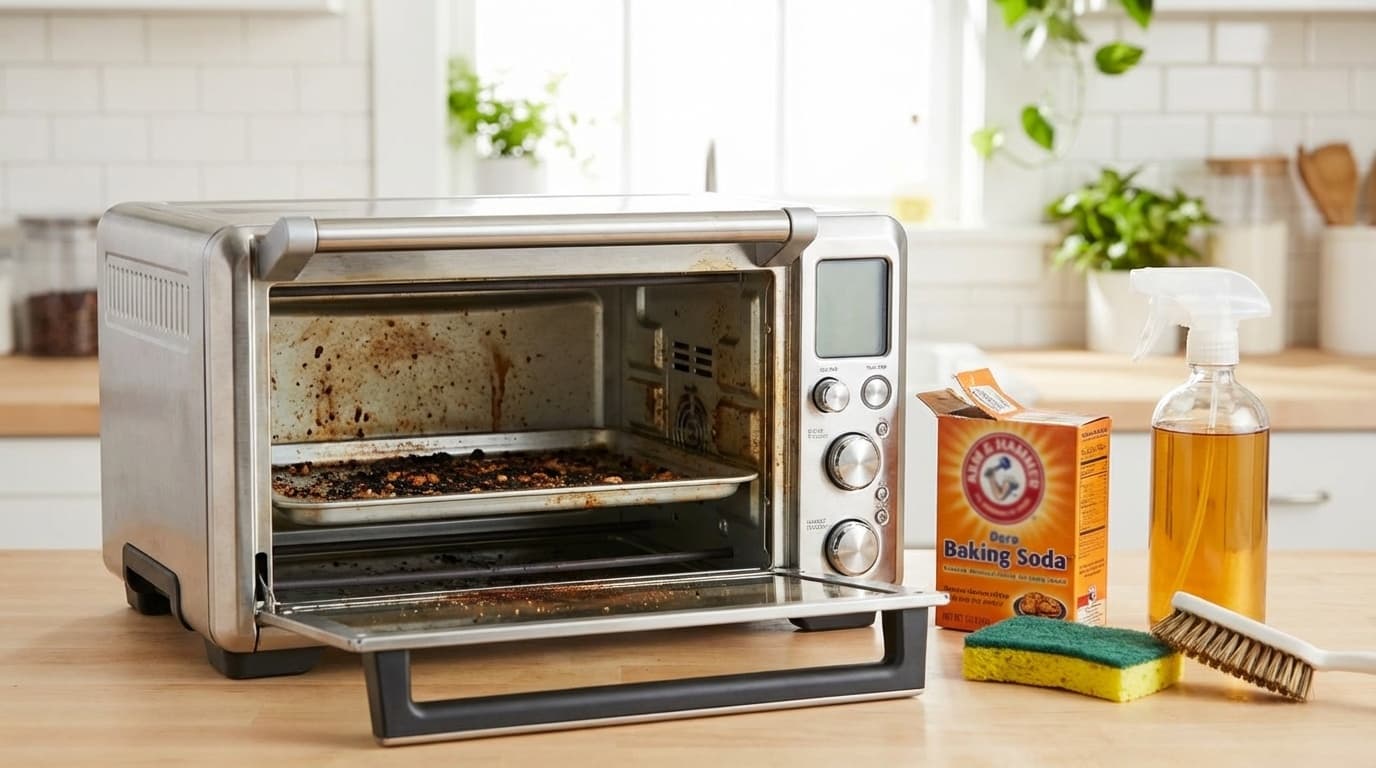
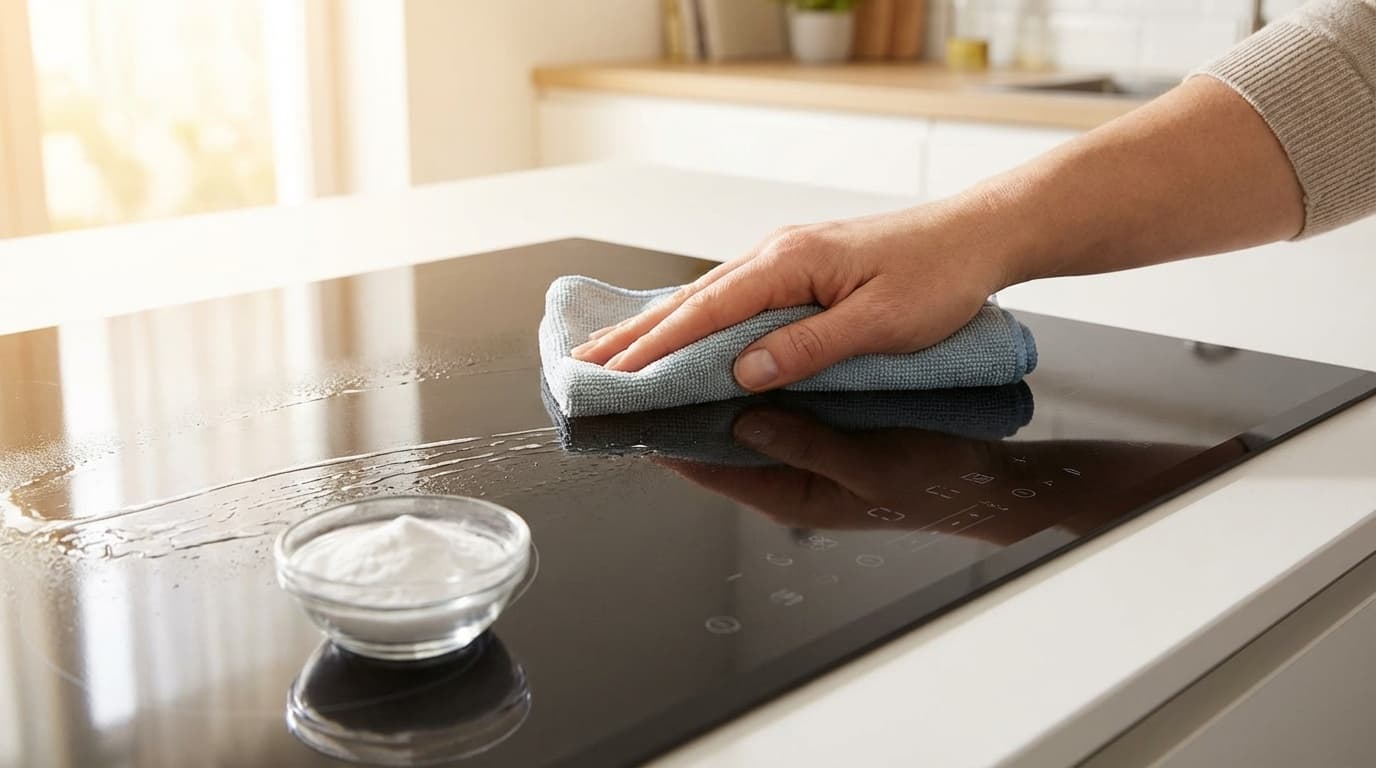
How to remove burnt residue: Baking soda + aluminum foil (or plastic wrap)
Use the abrasive power of baking soda to remove burnt spots that mild detergents cannot match. This is a standard method that can be done at home and is also introduced in Kao Cleaning Guide.
- Sprinkle baking soda powder evenly over the burnt part
- Sprinkle a small amount of water to moisten it (it is OK if it becomes paste-like)
- Crump up the aluminum foil and rub it gently in a circular motion
- If dirt appears, wipe it off with a cloth dampened with water
- If it doesn't come off completely, apply baking soda paste and leave it for 15-20 minutes before scrubbing again
If you don't have aluminum foil, you can use crumpled plastic wrap instead. If you use a sponge, it will absorb the baking soda and reduce its polishing power, so we recommend using aluminum foil or plastic wrap.
Cream cleanser for stubborn burns
For stubborn burns that cannot be removed even with baking soda, use a cream-type cleanser (such as Jif). Powder-type cleansers have a high risk of scratching the glass, so be sure to choose a cream-type cleanser.
- Apply an appropriate amount of cream cleanser to the burnt area
- Gently rub with a rolled up piece of plastic wrap or aluminum foil
- Do not use too much force and draw small circles
- Finish with wet wipe → dry wipe
Panasonic's official FAQ also recommends using a combination of cream cleanser and aluminum foil to remove stains that are difficult to remove.
How to remove marks from the bottom of the pot: patiently with cream cleanser
Metal marks on the bottom of the pot are different from burnt marks, so baking soda alone may not be able to remove them. Cream cleansers are also effective in this case. The procedure is the same as for burnt stains, but since it is often not possible to remove them completely in one go, the trick is to remove them little by little in several steps.
5 cleaning mistakes that will damage the glass top
The top plate of the IH is made of crystallized glass (heat-resistant ceramic glass). It may look durable, but if you clean it incorrectly, you'll end up with small scratches, which become a vicious cycle where dirt gets trapped and becomes even more difficult to remove. Survey of professional house cleaning companies (Your Meister) also pointed out the following unacceptable practices.
NG1: Scrub with metal scrubbing brush/steel wool
If you scrub it with a metal scrubber even though the dirt won't come off, you'll end up with countless small scratches on the glass surface. Once the damage is done, it cannot be undone, so please refrain from doing so.
NG2: Use a powder type cleanser
Powder cleansers have coarse abrasive particles and are too aggressive for glass tops. Be sure to use the cream type.
NG3: Scrape off the burnt area with a metal spatula or knife
You may think that ``just scraping it off will make it easier,'' but it can cause deep scratches on the glass. You can use a scraper made specifically for IH (plastic), but avoid using metal.
NG4: Use chlorine bleach or alkaline detergent
Chlorine bleach such as Kabi Killer and Kitchen Hiter can damage the surface coating of glass, causing it to become cloudy or discolored. Strong alkaline detergents for residential use are also no-no. Use neutral detergent for IH.
NG5: Lay down a dirt prevention sheet/mat
Some people put silicone mats or aluminum sheets on top of the IH to "prevent it from getting dirty," but this is clearly prohibited by the manufacturer. The temperature sensor of the IH may not function properly and in the worst case, it may lead to a fire. Panasonic's official FAQ page also states that ``Do not use commercially available dirt prevention covers.''
Do not collect dirt! Preventive habits that can be done in 30 seconds every day
The best way to prevent stains on your IH is to wipe them as soon as they get on them. Burnt and oily stains become more difficult to remove as time passes.
- After cooking, wipe the top plate with water as soon as it cools down: This alone can prevent 80% of oil splashes. Wipe after the high temperature warning lamp goes out
- Wipe it up immediately if it spills: Just wipe it with a damp cloth before the broth or seasonings burn onto the glass surface
- Check for dirt on the bottom of the pot: If the bottom of the pot or frying pan is burnt, it will be transferred to the IH side. If you clean the bottom of the pot regularly, the IH itself will be less dirty
- Wipe the entire surface once a week with a mild detergent to prevent an invisible oil film from building up. Finish by dry wiping to restore the luster of the glass
FAQ
Is it okay to use melamine sponge (Geki Ochikun) on IH?
It can be used for light stains, but rubbing too hard may cause small scratches. Try it in an inconspicuous place before using it, and don't use too much force. Baking soda + aluminum foil is safer for stubborn burns.
Can I use sesquicarbonate of soda or citric acid instead of baking soda?
Sodium sesquicarbonate is effective for decomposing oil stains, but it is not suitable for removing burnt dirt as it has no abrasive power. Citric acid is effective against limescale, but it is less effective against burnt IH and oil stains. Baking soda is best for IH burns.
Which is better, IH dedicated cleaner or commercially available cream cleanser?
A cream cleanser (such as Jif) is sufficient for daily burn removal. Induction-specific cleaners are effective if you want to further reduce the risk of scratches, as manufacturers have tailored abrasive particles for glass tops. The price is around 500 to 1,000 yen, and you can purchase it at home centers or online.
What should I do about stains that just won't come off?
If it does not come off no matter how many times you try baking soda or cream cleanser, the glass surface may be scratched and dirt may have gotten into it. In this case, it is difficult to remove it on your own, so consult the manufacturer's repair center or a house cleaning company.
References
- Cleaning the top plate | Care guide | IH cooking heater — Panasonic Corporation
- [Easy burnt on food] Easy way to clean an IH cooking heater! — Kao My Kao
- How should I clean the top plate? — Hitachi Global Life Solutions Co., Ltd.
- Explaining how to clean and maintain an IH cooking heater — Mitsubishi Electric "Kuratoku"
- What you should not do when cleaning an IH cooking heater — Your Meister