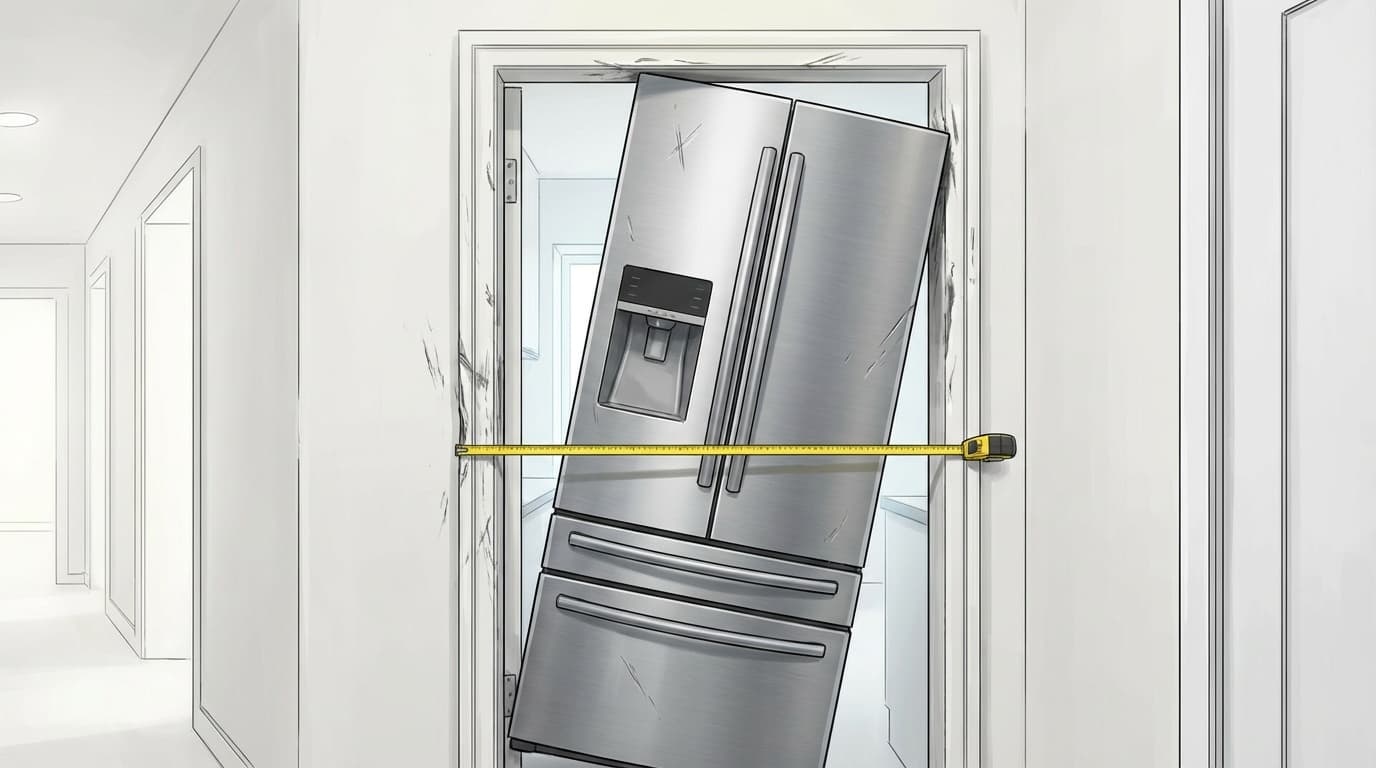
"I received a new refrigerator, but I can't get in through the front door..." In fact, this problem has been reported quite often when replacing large refrigerators at home appliance retailers or online. In some cases, if the item cannot be delivered on the day of delivery, cancellation fees and re-delivery fees may be charged.
In this article, based on information as of March 2026, we will explain in an easy-to-understand manner the 5 entry routes that you should always measure before purchasing a refrigerator, and what to do in the unlikely event that the refrigerator does not fit.
Why does the refrigerator not work? Three common causes
In the first place, why can't the refrigerator I just bought fit into my house? There are generally three reasons.
1. Measuring only the installation space and not measuring the delivery route
The most common failure pattern is measuring the refrigerator space in the kitchen, but not the width of the entrance, hallway, or elevator. For a refrigerator, not only the place where it is placed, but also all the places it passes through must be larger than the size of the refrigerator itself.
2. Overlooking the protrusions of doorknobs, handrails, mailboxes, etc.
Even if you think you have measured the width of your front door, many people do not subtract the protrusion of doorknobs and mailbox holders. The actual passing width may be 5 to 10 cm narrower than the apparent width.
3. You think it's the same size as your previous refrigerator.
Recent refrigerators tend to have larger capacities, and even if you think it's okay because it's the same 400L class, the outside dimensions may be several centimeters larger. Please be careful as more and more models are becoming particularly deep.
5 delivery routes you should measure before purchasing
To prevent problems when transporting a refrigerator, it is a golden rule to measure 5 points before deciding to purchase. The guideline is ``the width (or depth) of the refrigerator + 10 cm or more''. When going up stairs, the safety line is "+20 cm or more" (Hitachi Official Support and Rank King's Commentary).
1. Entrance door (effective opening width)
With the door fully open, measure the width by subtracting the protrusions of the doorknob, post holder, chain lock, etc.. In the case of a hinged door, if the door is structured to only open 90 degrees, the door itself will narrow the passage width, so be sure to check.
2. Common corridor/Apartment passage
If you live in an apartment, measure the width and ceiling height of the common hallway in front of the entrance. Be especially careful of L-shaped or crank-shaped hallways. Since you will need to tilt and rotate the refrigerator around bends, you cannot judge by just the straight width.
3. Elevator (inner dimensions)
Even if an apartment building has an elevator, the elevators in older apartment buildings may be small. Please measure the inside width, depth, and height. Especially if the elevator is shallow, there are cases where you cannot enter the elevator with the refrigerator upright. If you cannot use the elevator, you will have to carry the item up the stairs, which will incur an additional charge (typically 1,000 to 2,000 yen per floor).
4. Indoor corridors and corners
Measure the width of the hallway from the entrance to the kitchen and the space around the corner. If the width of the hallway is less than 70 cm, even a regular refrigerator with a width of 65 cm will be barely enough. If there is a corner, please also check the space of about 1m before and after the corner.
5. Kitchen installation space (including heat radiation space)
Finally, the installation location itself. Refrigerators need to release heat to the outside in order to cool the inside. According to Panasonic official, a heat dissipation space of 5cm or more on the top and 0.5-1cm or more on the left and right (5-10cm on the sides depending on the model) is required. If the space is exactly the same as the size of the main unit, it may be possible to install it, but it may not cool properly or cause a malfunction.
It didn't arrive on the day of delivery! 5 ways to deal with it
You forgot to measure it on the day of delivery, or you thought you had measured it but it just didn't fit. Here are five ways to deal with such situations.
Countermeasure 1: Have the door/handrail removed
If you remove the hinges of the entrance door, the passage width will increase by 5 to 10 cm. The same goes for interior doors. In some cases, width can be secured by removing the handrails of the stairs. Some delivery companies can help, but it's faster if you provide your own driver.
Countermeasure 2: Bringing in through the window
If there is a kitchen on the first floor, you may be able to give up on the entrance and move in through the sleep window or balcony window. Although it is necessary to remove the window, this method seems to solve the problem in many cases. However, if the windows are on the second floor or above, a crane will be required.
Countermeasure 3: Arrange for crane delivery
If you cannot enter through the entrance or stairs, there is a way to lift it with a crane and bring it in through the balcony or window. The average cost is around 20,000 to 30,000 yen, but the conditions are that the house faces a main road where the crane truck can be parked and that there are no obstructions such as power lines (from EHS official website).
Countermeasure 4: Ask a moving company
Even if the home electronics retailer's delivery company deems it impossible, a moving specialist may be able to help. Movers are used to narrow entry routes and have specialized materials for curing (protecting walls and floors). If you get quotes from multiple companies, you may be able to get a surprisingly low price.
Solution 5: Change size/return
If all of the above doesn't work, consider exchanging for a smaller model or returning. If you purchase it at a home electronics retailer (Yamada Denki, Bic Camera, etc.), they will often accept a size change if you let them know that they were unable to transport it. In the case of online shopping, in most cases it is possible to returnif the outer box is unopened. However, shipping and cancellation fees may apply, so we recommend checking the return policy before purchasing.
Things you should do before purchasing for peace of mind
To avoid any trouble during delivery, please do the following three things before purchasing.
Use an installation preview service
Major electronics stores and official manufacturers' mail order services offer free previews of the delivery route. Bic Camera Refrigerator Purchase Guide also recommends checking in advance. It is best to make your request before the purchase is confirmed and at least one week before the scheduled delivery date.
Check the actual size using a measuring tape and a pattern
It will be easier to understand by checking the external dimensions of the refrigerator on the manufacturer's official website, making a pattern of the same size from cardboard or newspaper, and walking it through the delivery route.
Consider a "slim width" model
Recently, various manufacturers have released large-capacity models of 400L or more even in the "slim width type" with a width of 60 cm or less. If you are concerned about transport, it is also a good idea to prioritize width over capacity when choosing a model.
FAQ
How much width allowance do I need to transport the refrigerator?
Generally, you need at least 10cm of extra space in addition to the width (or depth) of the refrigerator. When passing through stairs, it is safe to have at least 20 cm. However, if there is a gap of less than 5mm, most delivery companies will refuse your order.
Will there be an additional charge if the delivery does not arrive on the same day?
If the delivery company takes the item back, re-delivery fees and cancellation fees may apply. The amount varies depending on the store and delivery company, but generally ranges from a few thousand yen to 10,000 yen. If you are arranging for a crane to be brought in, it will cost an additional 20,000 to 30,000 yen.
Is it okay to transport the refrigerator on its side?
Basically no. Refrigerant contains refrigerant (compressor oil) inside the refrigerator, and if you lay it on its side, the oil will circulate in the cooling circuit and cause a malfunction. If it is unavoidable to tilt the unit, the manufacturer recommends that it be tilted no more than 30 degrees and wait at least one hour after installation before turning on the power.
What should I do if I can't get into the apartment elevator?
It will be delivered by stairs. The average additional fee is 1,000 to 2,000 yen per floor. If you are on the 3rd floor or higher and it is difficult to bring in the stairs, consider bringing in a crane (20,000 to 30,000 yen) or moving in through a window. It will be smoother if you consult with the delivery company in advance.
If I bought a refrigerator online and it doesn't fit, can I return it?
Many shops allow you to return items if the outer box (presentation box) is unopened, but the handling varies depending on the store. Be sure to check the return and exchange policies before purchasing. Electronics retailers tend to have a smoother process of handling size changes and returns if they are unable to deliver the item.
References
- How to install a refrigerator | Installation location and precautions when transporting! — Panasonic UP LIFE
- I would like to know the space required to bring in the refrigerator — Hitachi Home Appliances Support Page
- Things to keep in mind when transporting a refrigerator | It's too wide to fit into the room! — Rank King
- We were refused delivery of the refrigerator! How to deal with this and choosing a company that can handle difficult imports — EHS Co., Ltd.
- Flow from refrigerator purchase to installation — Bic Camera