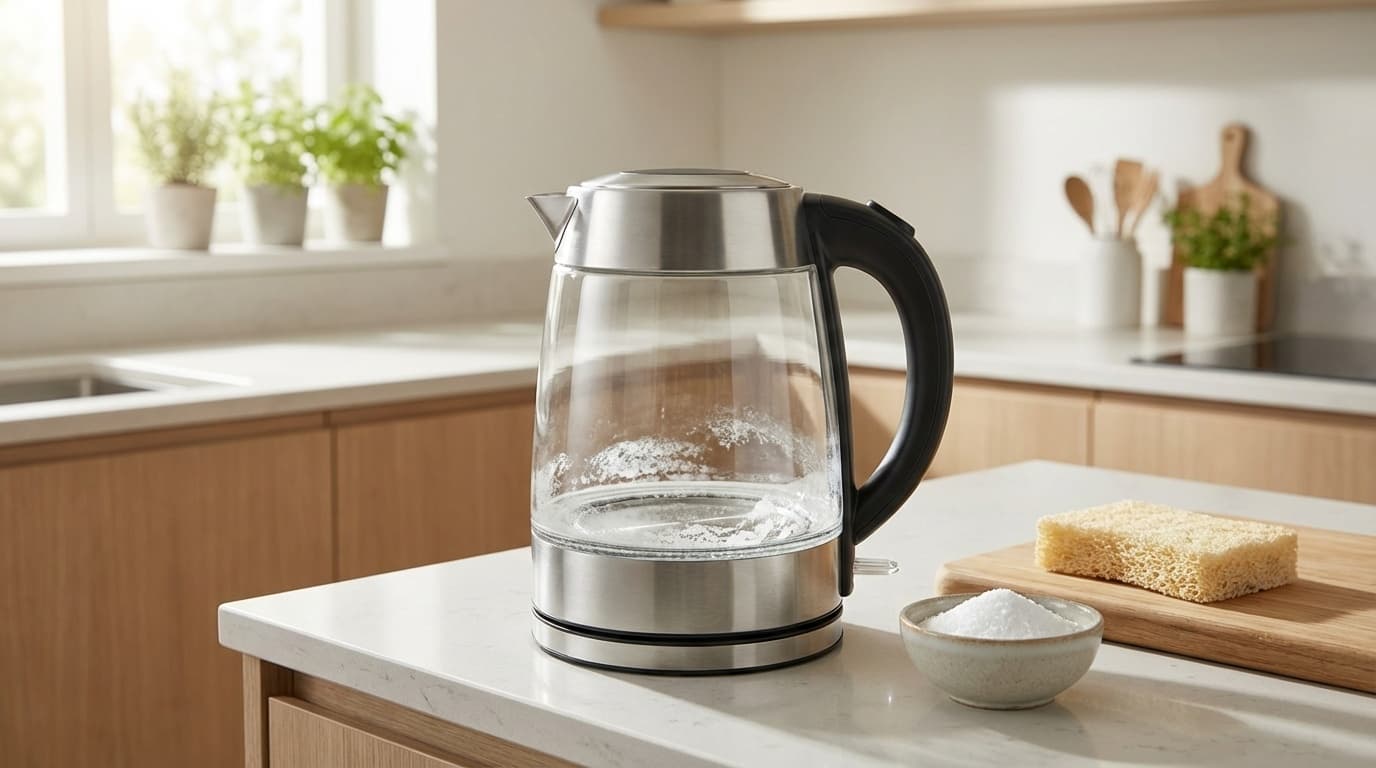
Are you worried about white rough dirt stuck to the bottom or inside of your electric kettle? Some people are worried about ``mold?'' but that is actually ``limescale,'' a solidified form of mineral components such as calcium and magnesium contained in tap water. There is no harm to your health if you drink it, but if you leave it unattended, it not only looks dirty, but also takes longer to boil and causes the water to smell like limescale.
In this article, we will explain the correct use of citric acid, baking soda, and vinegar, as well as the steps to thoroughly remove white stains, based on information as of March 2026. We will even introduce a method for dealing with stubborn stains for people who have tried citric acid but it didn't come off, so please read to the end.
What is the white stain on the electric kettle? “Lake scale” instead of mold
First of all, I want you to be reassured that that white stain is not mold. When you boil tap water, only the water evaporates, and the minerals dissolved in the water (mainly calcium and magnesium) crystallize and remain. This is the true nature of the white powder-like roughness.
In other words, this is a natural phenomenon that will always occur in any kettle as long as you are using tap water. The same is true when using mineral water; in fact, hard water with a high mineral content is more likely to get dirty.
Although limescale itself is harmless to the human body, it has the following disadvantages, so regular cleaning is recommended.
- Decrease in boiling efficiency: When limescale builds up on the bottom, it becomes difficult for the heater to transmit heat, resulting in wasted electricity bill
- Calcium odor: Hot water has an unpleasant odor that reduces the taste of coffee or tea
- Unsanitary appearance: A bit embarrassing when visiting guests
How to use citric acid, baking soda, and vinegar | Differences between "inside" and "outside"
Many people think that just adding citric acid will do the trick, but in reality, the detergent to use differs depending on the type of dirt. If you make a mistake, it won't fall at all, so be sure to hold it firmly.
White limescale on the inside → citric acid or vinegar (acidic)
The white dirt inside the kettle has alkaline properties. Therefore, the correct answer is to neutralize and dissolve it with acidic citric acid or vinegar. According to Ji no Shiosha's official information, citric acid is a natural ingredient found in lemons and pickled plums, and is also used as a food additive, so it can be safely used in kettles that handle food that is put into the mouth.
External hand stains and oil stains → Baking soda (weakly alkaline)
On the other hand, the stains on the outside of the kettle are mainly from hand marks and oil splatters, which are acidic stains. Weakly alkaline baking soda is effective for acidic stains. Haseko's commentary article also recommends using baking soda on the outside and citric acid on the inside.
Summary table
| Location of dirt | Type of dirt | Detergent to use |
|---|---|---|
| Inner side (scale/white crystals) | Alkaline | Citric acid or vinegar |
| Outside (hand stains/oil stains) | Acidic | Baking soda |
| Gap between spout and lid | Mixing | Citric acid → baking soda |
[Procedure] How to remove white stains from the inside with citric acid (set complete in 5 minutes)
The most basic and most effective method is using citric acid. According to Kojicaji's explanation, all you need is citric acid and water. Let's proceed by following the steps below.
Things to prepare
- Citric acid: 1 tablespoon (approx. 15g) *Available at 100 yen stores and drugstores
- Water: Kettle full water line
- Soft sponge
Steps
- Fill to the full line: Pour water into the kettle to the full line
- Add citric acid: Dissolve 1 tablespoon of citric acid in water
- Boil: Turn on the kettle and boil it normally
- Leave for 1-2 hours: After boiling, let the water cool with the lid closed. During this time, citric acid dissolves limescale
- Discard the hot water and scrub with a sponge: Gently scrub the inside with a soft sponge
- Rinse 2-3 times with water: completely wash away any citric acid residue
With just this, most white stains can be removed.
If you don't have citric acid, you can use vinegar instead
If you don't have citric acid on hand, you can also use edible vinegar (grain vinegar). Vinegar is also acidic, so it uses the same principle to dissolve limescale.
The method is simple: fill the pot with water, add 2 to 3 tablespoons of vinegar, bring to a boil, and leave for 1 to 2 hours. However, vinegar tends to leave behind a unique odor, so be sure to rinse thoroughly at least three times. For people who are concerned about smells, citric acid is recommended.
It still doesn't fall! 3 ways to deal with stubborn water stains
If you say, ``Even though I boiled it with citric acid, it doesn't come off at all...'' There is a possibility that the limescale has become thick and has many layers. Try the methods below.
Countermeasure 1: Increase the concentration of citric acid
Usually 1 tablespoon, but for stubborn stains, try increasing the amount to 2 to 3 tablespoons. Kakaku.com Magazine also recommends increasing the amount of citric acid if the dirt is heavy.
Countermeasure 2: Extend the leaving time (leave overnight)
If it does not come off in 1 to 2 hours, the effect will be improved by boiling and leaving it overnight (6 to 8 hours). By leaving it on for a long time, the thick layer of limescale will slowly dissolve.
Countermeasure 3: Repeat 2-3 times
It's okay if you don't get it perfect the first time. Repeat the same procedure two or three times to dissolve the accumulated limescale layer by layer. Do not try to forcefully remove it in one go as this will damage the coating inside the kettle.
Bad actions that should not be done
- Scrubbing with a metal scrubber or melamine sponge: The internal coating may peel off, causing rust and deterioration
- Add chlorine bleach (such as Hyter): When mixed with citric acid, toxic chlorine gas is generated, which is very dangerous
- Add dish detergent and boil: It may bubble over and boil over. Use only for cleaning outside
Prevent limescale! 5 preventive measures you can take on a daily basis
Cleaning is important, but if you take measures to prevent dirt from accumulating in the first place, you can significantly reduce the frequency of deep cleaning.
- Throw away the water after each use: If you leave the remaining hot water out, the water evaporates and limescale builds up. Once boiled, use it immediately or throw away the rest
- Open the lid and let it dry: After discarding the water, open the lid and dry the inside thoroughly. If moisture remains, it can cause the growth of bacteria
- Make citric acid cleaning a habit once a month: According to Tokyo Gas official explanation, regular cleaning once every 1 to 3 months is recommended. If the dirt is light, it can be completed in 5 minutes
- Use water that has been passed through a water purifier or cartridge: Mineral content is reduced, making it less likely that limescale will build up (although it cannot be completely prevented)
- Avoid hard mineral waters: Hard waters such as Evian and Contrex have high calcium content and are prone to limescale formation
FAQ
Is the white dirt on the electric kettle bad for your health? Is it okay to drink?
The white stains are actually mineral components such as calcium and magnesium contained in tap water. Since it is not a substance harmful to the human body, there is no harm to your health even if you drink boiled water. However, regular cleaning is recommended as this will affect the appearance and taste.
Is it bad to use citric acid and baking soda at the same time?
If you add citric acid (acidic) and baking soda (alkaline) at the same time, foam will be produced due to the neutralization reaction, but they will cancel each other's cleaning power. Although this combination is effective for cleaning drains, it has the opposite effect on removing limescale from kettles. Use citric acid on the inside and baking soda on the outside, both separately.
What is the best cleaning frequency?
Tokyo Gas's official explanation recommends cleaning once every 1 to 3 months. If you use it every day, use it once a month, and if you use it only occasionally, use it once every three months to prevent dirt from accumulating. When white dirt becomes visible, it is a sign that cleaning is required.
Is the cleaning method different for stainless steel and plastic?
The basic cleaning method (boiling with citric acid and leaving it) is the same for both. However, plastic kettles are easily scratched, so use a softer sponge when scrubbing. Stainless steel may discolor if soaked in citric acid for too long, so avoid leaving it in citric acid for more than one night.
References
- Clean [white crystals and scale stains] from pots and kettles with citric acid! — Ji no Shiosha
- Clean your electric kettle with citric acid or baking soda! Introducing cleaning methods — Haseko Group “Blanc Sierra Club”
- How to wash an electric kettle? Detailed explanation of cleaning methods using citric acid, etc. — Tokyo Gas
- Cleaning the electric kettle|Citric acid for white marks! Explaining how to clean in 5 minutes — Kojikaji
- How to clean an electric kettle - Clean easily with citric acid and baking soda! ― — Kakaku.com Magazine