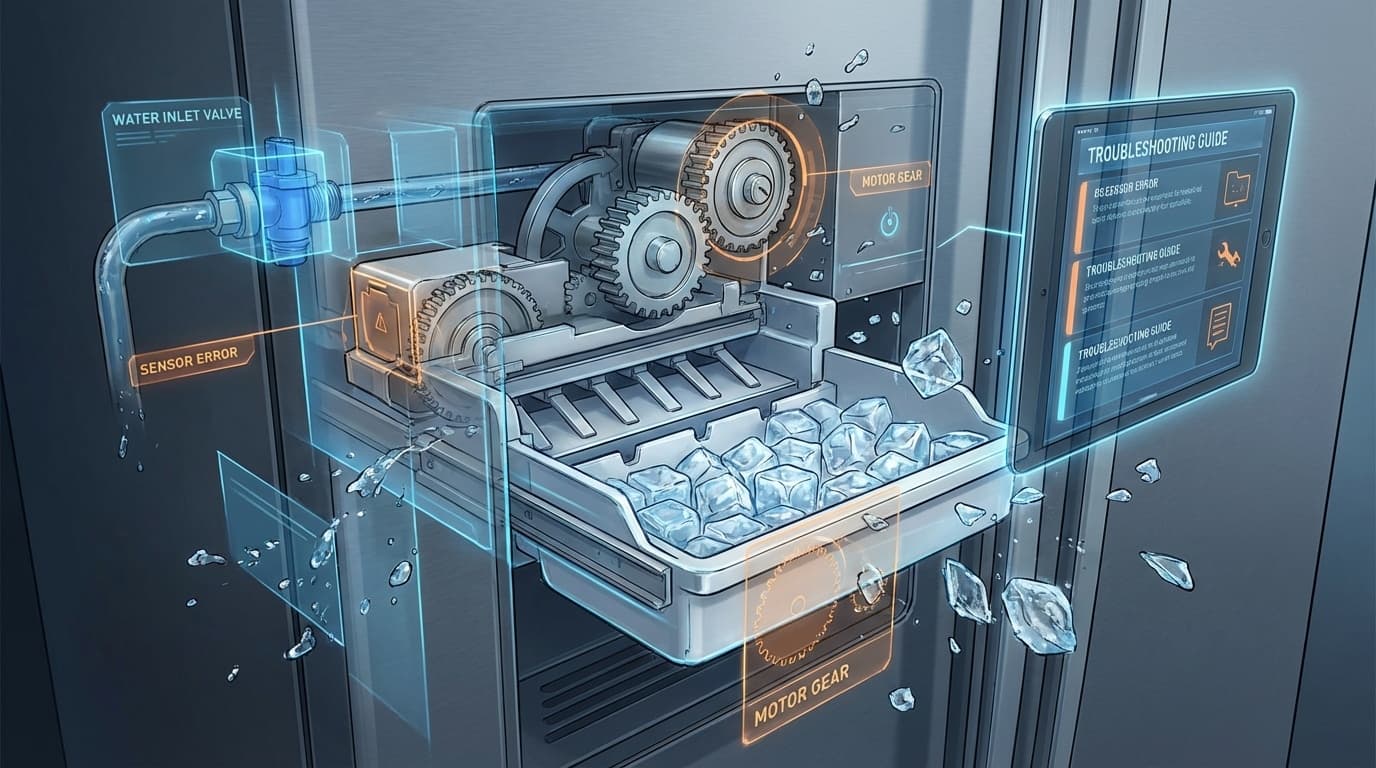
"Oh, there isn't any ice in the refrigerator..." The next thing I knew, the ice maker was empty. Not having ice in the hot summer is quite stressful, isn't it? But wait a minute. In many cases, you can fix the problem yourself before thinking that the ice maker is malfunctioning and calling for repairs. In this article, we will explain one by one the reasons why your refrigerator's ice maker may not be producing ice, and introduce ways you can fix the problem yourself. We have also summarized the precautions for each manufacturer.
Check first! 3 basic checks for ice makers
Before calling for repair, check these three things first. Surprisingly, this alone often solves the problem.
Check 1: Is the ice making function turned on?
Is the ice-making function set to "stop" on the refrigerator's operation panel? You may accidentally press the button while cleaning, or your family may turn it off without your knowledge. The location of the buttons differs depending on the manufacturer, so please check the instruction manual. If you lose the instruction manual, you can download the PDF from the manufacturer's website.
Check 2: Is there water in the water tank
This is surprisingly a blind spot. If the water tank is empty, ice will obviously not form. Take out the tank and refill it with water. Basically, use tap water. Manufacturers do not recommend using mineral water or water from a water purifier as it is easy for bacteria to grow there.
Check 3: Is the water tank set correctly?
If the tank is not inserted all the way, water will not be supplied. Once you take it out, push it in firmly until you hear a click. Please check that the gasket has not come off.
Cause: How to fix when the ice maker doesn't make ice
Cause 1: Clogged water filter
For models with a filter on the water tank, the filter may become dirty and the water flow may be poor. Remove the filter and wash it with water. If it is heavily soiled, it needs to be replaced. The recommended filter replacement is once every 3 to 4 years. You can purchase replacement filters from each manufacturer's official website.
Hitachi Refrigerator Support, Panasonic Refrigerator, Mitsubishi Electric Refrigerator.
Cause 2: Freezing water pipes
If the temperature inside the refrigerator is set to "High", the water supply pipe may freeze and water may stop flowing. The solution is to return the temperature setting of the refrigerator to ``medium''. Then, remove the water tank and wash it with lukewarm water (about 40 degrees) to remove the frost around the tank.
If the pipe is frozen, turn off the ice-making function and wait 12 to 24 hours until it thaws naturally. Do not heat it with a hair dryer! Plastic parts may become deformed.
Cause 3: Dirty/deteriorated ice tray
If the ice tray (the tray part that makes ice) is dirty or the surface coating has peeled off, the ice may not peel off properly and remain in the ice tray. Remove the ice cube tray and wash it with a mild detergent.
If your ice cube tray is old and ice starts to stick to it, it's a sign that it needs to be replaced. Replacement ice trays can be purchased from many manufacturers for around 1,000 to 3,000 yen. Please check the model number before ordering.
Cause 4: Too much ice builds up in the ice maker
When the ice maker is full of ice, the detection sensor determines that there is enough ice and stops making ice. However, if the ice sticks together and hardens, the sensor may mistakenly think it is ``full'' when it is actually empty.
The solution is to take out all the ice from the icemaker and break up the frozen ice. Then, when you put it back in, gently put it back in. Ice making will stop if the detection lever (rod-shaped sensor) is pushed up by ice, so make sure the lever is down.
Cause 5: Defective cooling of the refrigerator itself
If the entire refrigerator is not cooling properly, the problem is not just with the ice maker. If the refrigerator compartment is lukewarm or the ice cream in the freezer compartment is melting, there is a problem with the refrigerator itself.
The first thing to check is Is there a gap of 5cm or more between the back or sides of the refrigerator and the wall? If heat dissipation space is not secured, cooling efficiency will decrease. Also, if the refrigerator is overcrowded, cold air won't circulate. A capacity of about 70% is ideal.
Notes by manufacturer
Panasonic: Some models come with an automatic ice-making "cleaning" function. Perform cleaning operations periodically from the operation panel. You can check the instruction manual by model number at Panasonic Refrigerator Support.
Hitachi: Models equipped with "vacuum chilled" have a unique structure of the freezer compartment. Be careful as it is easy to forget to change the filter in the water tank. You can also purchase parts from Hitachi Refrigerator Support.
Mitsubishi Electric: Models equipped with "snap-out supercool freezing" have an ice-making compartment and a supercool freezing compartment adjacent to each other. If you put too many things in the supercool freezer compartment, ice making may be affected.
Sharp: For models equipped with "Plasmacluster", also check when to replace the Plasmacluster unit. You can search for model numbers at Sharp Refrigerator Support.
If the problem still persists, please request repair
If you have tried all the methods above and still cannot make ice, there may be a problem with the ice maker's motor, sensor, or control board. If this happens, it will be difficult to repair it yourself, so contact the manufacturer's repair service.
Estimated repair cost is about 15,000 to 30,000 yen including travel expenses. If it has been more than 10 years since your purchase, repair parts may no longer be manufactured. In that case, you may want to consider replacing it.
Before requesting repair, it will be easier to make a note of the refrigerator model number (written on the sticker inside the door). Manufacturer repairs can be requested through the company's website or by phone.
FAQ (Frequently Asked Questions)
How long does it take to make ice?
With a typical household refrigerator, it takes approximately 2 to 3 hours to make ice once. Allow about 4-5 hours for the first ice to form after refilling the water tank. It may take longer in the summer or when the refrigerator is opened and closed frequently.
Is it bad to make ice with mineral water?
Most manufacturers recommend tap water. Tap water contains chlorine, which has the effect of suppressing the growth of bacteria. Since chlorine has been removed from mineral water and water from water purifiers, mold can easily grow in tanks and water supply pipes. If you really want to use it, you will need to clean it frequently.
How often should I clean my ice maker?
Ideally, the water tank and ice tray should be washed once a week. We recommend cleaning the filter once a month and replacing it once every 3 to 4 years. Please also refer to the maintenance schedule listed in the instruction manual.
Should I turn off the ice maker in winter?
If you don't use much ice in winter, it's a good idea to turn it off. This will save you money on electricity bills and reduce the risk of water pipes freezing. If you want to turn it off, drain the water from the water tank and wash it. If it remains, bacteria will breed.
I can't make ice anymore after moving?
After moving the refrigerator, wait at least 24 hours after installation before turning on the ice-making function. This is because it takes time for the refrigerant to stabilize. Also, make sure to reset the water tank and make sure that the refrigerator is installed horizontally.
References
- Refrigerator support and care information — Panasonic
- Refrigerator support page — Hitachi Global Life Solutions
- Refrigerator product information — Mitsubishi Electric
- Refrigerator support page — Sharp