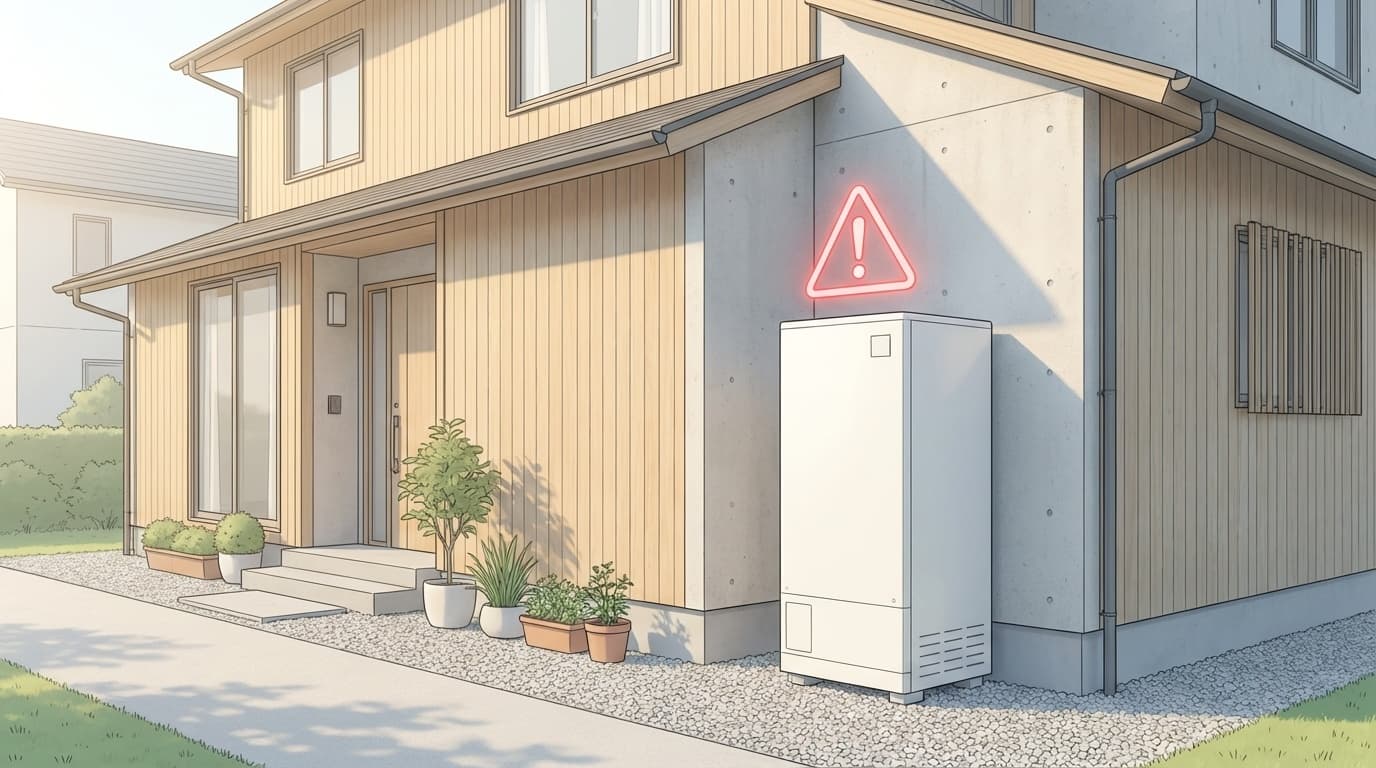
“I was about to take a morning shower and there’s no hot water!” “There’s an error code on the remote!” — when an EcoCute water heater suddenly acts up, it can throw your whole day into panic mode.
In this article, based on information available as of March 2026, we’ll explain six likely reasons your EcoCute isn’t producing hot water, quick fixes you can try yourself, and how to decide whether to repair it or replace it. We’ll also cover the 2026 Hot Water Energy-Saving Program subsidy of up to 120,000 yen, so use this as a practical starting point.
How Does an EcoCute Water Heater Work?
EcoCute is a water heater that uses heat pump technology — a system that pulls heat from the air — to heat water, usually with lower-cost overnight electricity, then stores it in a large tank. In simple terms, it makes hot water at night and you use that stored hot water during the day.
An EcoCute system is made up of two main units.
- Heat pump unit — the outdoor-unit-looking component that gathers heat from the air and heats the water
- Hot water storage tank unit — the large tank that stores the heated water
If either unit has a problem, you may lose hot water. According to Daikin Industries’ official explanation, a typical EcoCute system lasts about 10 to 15 years.
6 Reasons Your EcoCute Isn’t Producing Hot Water
No hot water is stressful, but depending on the cause, you may be able to fix it yourself. Start by checking which of these situations fits.
Cause 1: You’ve Run Out of Hot Water in the Tank
This is the most common cause. If you had guests over, used more hot water than usual, or kept adding hot water to the bath, the tank may simply be empty.
👉 What to do: Press the “extra heating” or “boost” button on the remote to manually start heating more water. It depends on the model, but you’ll usually have usable hot water again in about 1 to 2 hours.
Cause 2: Frozen Pipes, Especially in Winter
When the outside temperature drops to around -4°C or lower, the pipes connecting the heat pump and storage tank can freeze, leaving you with no hot water or even no water at all. This can happen during a sudden cold snap, even outside traditionally cold regions.
👉 What to do: Open the mixed faucet on the hot-water side and, as a rule, wait for the pipes to thaw naturally. If you need to speed things up, wrap the pipe in a towel and slowly pour lukewarm water around 38 to 39°C over it. Never use boiling water, because it can damage the pipes.
Cause 3: The Earth-Leakage Breaker Has Tripped
After a typhoon, lightning strike, or leakage detection event, the dedicated earth-leakage breaker for the EcoCute may trip. When the breaker is off, the system stops heating completely.
👉 What to do: Open the front cover of the EcoCute unit, check the earth-leakage breaker, and switch it back on if it’s off. If it keeps tripping repeatedly, there may be an electrical leak, so call a professional right away.
Cause 4: The Water Supply Strainer Is Clogged
The water inlet on an EcoCute system has a strainer, or filter, that blocks debris and sand. If debris builds up there, water flow can weaken or stop, which can make the hot water come out poorly or not at all.
👉 What to do: Follow your owner’s manual to remove the strainer, then clean out the debris with a toothbrush or similar tool. Cleaning it once or twice a year is generally recommended.
Cause 5: An Error Code Is Showing on the Remote
If the remote shows an error code starting with “H,” “F,” “C,” “E,” or another letter, the EcoCute has detected some kind of internal abnormality.
According to Panasonic’s official FAQ, error codes fall into two broad groups: ones you can handle yourself and ones that require repair.
- Panasonic: Codes starting with “U” → often user-fixable. Codes starting with “H” or “F” → call for repair service
- Daikin: “U” codes are usually minor, while “H,” “E,” and “F” codes generally require professional service
- Mitsubishi Electric: If “P00,” “P10,” or “P11” appears, contact the seller or manufacturer
- Corona: Error codes are grouped into four categories by alphabet letter
👉 What to do: First, write down the error code shown on the remote, then check the owner’s manual or the manufacturer’s official website. If it’s a minor error, resetting the remote — power off, wait a few minutes, then power on — may clear it.
Cause 6: Aging Heat Pump or Circuit Board
If your EcoCute is more than 10 years old and none of the issues above apply, the problem may be a failed heat pump compressor or a deteriorated control circuit board. At that point, DIY repair is difficult, and you’ll need to ask the manufacturer or a service company about repair or replacement.
3 Temporary Fixes While You’re Without Hot Water
Repairs or replacement can take several days. Here are a few ways to get through the gap.
- Heat water with a portable cassette gas stove and a large pot, then add it to the bath. It’s old-fashioned, but it works.
- Use a nearby public bath or day-use hot spring. Some municipalities even offer discount coupons.
- Buy a portable shower, such as a battery-powered camping shower, online. They usually cost around 3,000 to 5,000 yen.
For dishes, you can get by by wearing rubber gloves and washing with cold water, or using disposable plates and utensils for a short time.
Repair or Replace? Use These 3 Rules of Thumb
When an EcoCute breaks down, the big question is whether to repair it or buy a new one. Use these three points to decide.
1. Has It Been in Use for More Than 10 Years?
According to Rehome Navi, the average lifespan of an EcoCute is 10 to 15 years. Once it’s past 10 years, another part may fail soon even if you repair the current issue, and the manufacturer may have stopped producing replacement parts. If it’s over 10 years old, replacement is often the realistic choice.
2. Will the Repair Cost More Than 100,000 Yen?
Here are rough repair cost estimates by repair type, as of March 2026.
- Circuit board replacement: 30,000 to 50,000 yen
- Mixing valve or pressure-reducing valve replacement: 15,000 to 30,000 yen
- Heat pump compressor replacement: 100,000 to 200,000 yen
- Storage tank leak repair: usually not repairable; replacement is recommended
Compressor and tank issues can get expensive fast. If the repair goes over 100,000 yen, replacing the unit often makes more sense overall.
3. Know the Typical Replacement Cost
According to E-Smile and Kyuto Depot, the typical cost to replace an EcoCute system, including the unit and installation, is roughly as follows.
- Hot-water-only type with basic functions: about 270,000 to 350,000 yen
- Fully automatic type with automatic tub filling and reheating: about 350,000 to 500,000 yen
- Premium model with high energy efficiency, solar integration, and similar features: about 450,000 to 550,000 yen
Installation work typically costs 100,000 to 150,000 yen, assuming there’s no difficult delivery route or special construction. In broad terms, many replacements fall in the 400,000 to 500,000 yen range.
The 2026 Hot Water Energy-Saving Program May Offer a Subsidy
If spending 400,000 yen or more sounds painful, there’s some good news. Through the Ministry of Economy, Trade and Industry’s “Hot Water Energy-Saving 2026 Program”, you may be able to receive a subsidy of up to 120,000 yen when replacing an EcoCute system.
According to Rehome Navi’s guide, the 2026 subsidy outline is as follows, based on information available in March 2026.
- Basic subsidy amount: 70,000 yen per unit
- Performance add-on: can increase the amount to up to 120,000 yen if the unit meets certain energy-saving performance or internet connectivity requirements
- Eligible construction period: work started between November 28, 2025 and December 31, 2026
- Important note: applications close once the budget limit is reached
Subsidy applications are handled through registered contractors, so when you request a quote, ask, “Can I use the Hot Water Energy-Saving 2026 Program subsidy?”
5 Warning Signs to Know Before It Breaks
To avoid a sudden breakdown, request an inspection early if you notice any of these signs.
- The water is lukewarm or the temperature isn’t stable — the mixing valve or thermostat may be deteriorating
- The shower pressure is weaker than before — the strainer may be clogged, or the pressure-reducing valve may be malfunctioning
- The heat pump is making unusual noises — high-pitched beeping or squealing can be a sign of fan motor failure
- Error codes appear frequently on the remote — if they keep coming back after clearing, aging parts may be the cause
- The area around the tank is wet — pipe connections may be deteriorating, or the tank itself may be leaking. Leaving it alone can also raise the risk of electrical leakage
If your EcoCute is more than 10 years old, getting a manufacturer inspection once a year, usually a paid service costing around 10,000 to 20,000 yen, can give you peace of mind.
FAQ
How Long Does an EcoCute Water Heater Last?
In general, 10 to 15 years is a good rule of thumb. The heat pump unit is often said to last 5 to 15 years, while the storage tank is typically around 10 to 15 years. The actual lifespan depends on the installation environment and how often it’s used.
If My EcoCute Breaks, Will a Technician Come Right Away?
It depends on the manufacturer and region, but 1 to 3 days after contacting them is common. In winter, repair requests pile up, so it can sometimes take more than a week. Contact them as early as you can.
How Much Does EcoCute Repair Usually Cost?
Depending on the part being replaced, repairs can range from 15,000 to 200,000 yen. A circuit board replacement may cost 30,000 to 50,000 yen, while a compressor replacement is usually around 100,000 to 200,000 yen. Travel fees and labor charges may be added separately.
Who Pays if an EcoCute Breaks in a Rental Home?
If the EcoCute is part of the rental property’s built-in equipment, the repair or replacement cost is generally the landlord’s responsibility. Contact the property management company or landlord first.
Can I Switch from EcoCute Back to a Gas Water Heater?
Technically, yes, but installing new gas piping can make the project expensive, sometimes over 500,000 yen. In most cases, replacing an EcoCute with another EcoCute is the more practical option.
References
- Could Your EcoCute Be Broken? Warning Signs You Shouldn’t Miss and Effective Ways to Respond — Daikin Industries, Ltd.
- [EcoCute] Why Has My Hot Water Flow Become Weak? — Panasonic Official FAQ
- EcoCute Error Sign List — Corona Corporation
- Hot Water Energy-Saving 2026 Program: Subsidy Amounts, Application Method, and Eligible Products in 5 Minutes — Rehome Navi
- How Much Does EcoCute Replacement Cost? Lifespan Guidelines and Tips for Choosing a Contractor — E-Smile