You turn the knob on your gas stove, but nothing lights... or you don't even hear the usual click-click-click. When that happens during a busy morning, it's stressful.
But don't panic. About 80% of gas stove ignition problems can be fixed on your own. In this article, we'll break down six common reasons a gas stove won't light and explain what to do for each one in plain English.
This guide is based on information current as of March 2026 and also references official guidance from major manufacturers such as Rinnai, Noritz, and Paloma.
Check These First: 6 Reasons Your Gas Stove Won't Light
There are six main reasons a gas stove may fail to ignite. Check them in order from the top, and in most cases you'll find the cause.
Cause 1: Dead Batteries (the Most Common One)
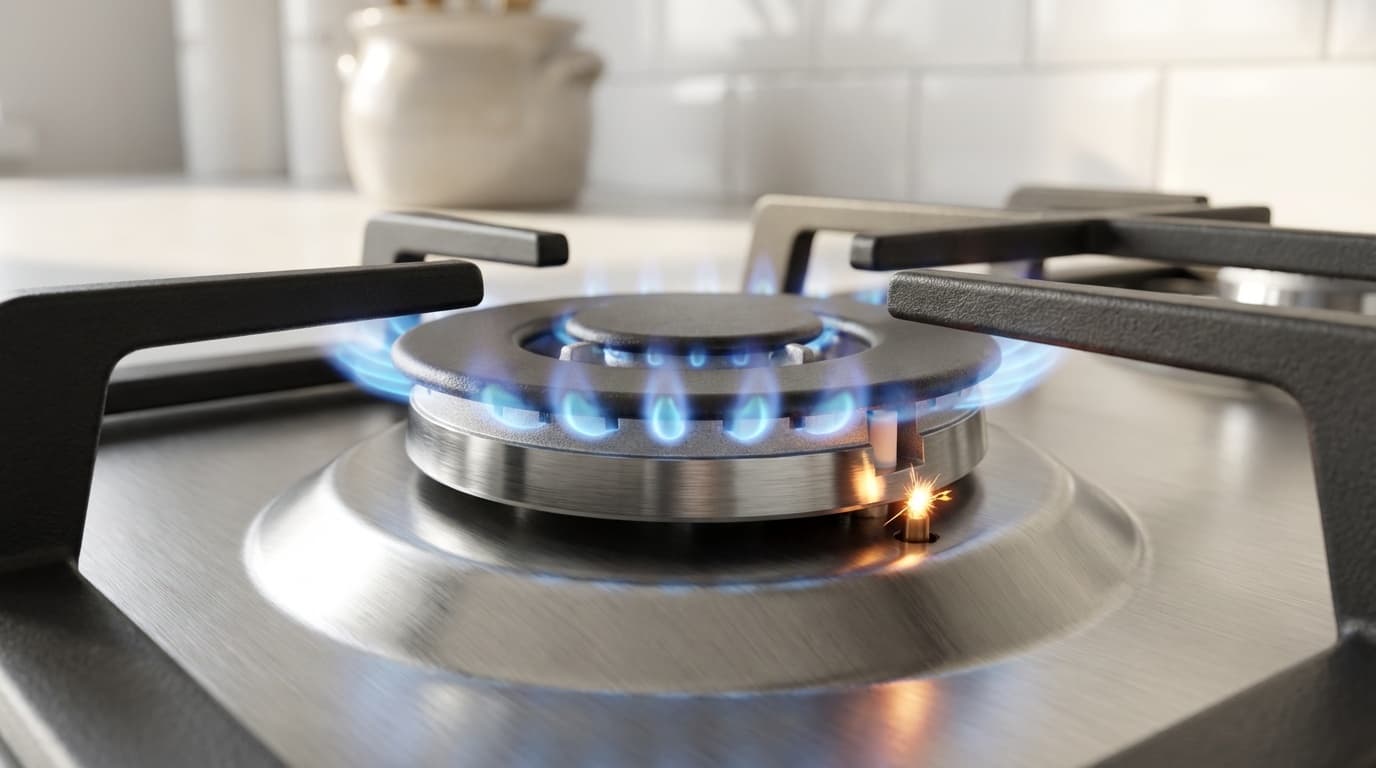
Gas stoves use batteries to create the click-click-click spark that lights the burner. So if the batteries are dead, there won't be a spark, and the flame won't light.
Many gas stoves have a low-battery indicator. If you see a red light blinking near the control panel, that's your sign to replace the batteries. It depends on how often you cook, but the usual replacement interval is about 1 to 1.5 years, according to the official Rinnai FAQ.
Cause 2: The Burner Cap Is Misaligned or Dirty
The burner cap is the round metal piece that sits over the area where the flame comes out. If it's not seated correctly after cleaning, the gas-air balance can be thrown off, making ignition difficult or impossible.
A clogged burner cap can also stop the stove from lighting, especially if food spills or grease have blocked the grooves. Use an old toothbrush or similar tool to gently clean out the grooves.
Cause 3: The Ignition Plug or Flame Failure Safety Device Is Dirty
The small protrusion next to the burner is the ignition plug. The other one is the flame failure safety device, also called a thermocouple or flame rod. If grease or moisture gets on these parts, the spark may not work, or the flame may light and then go out right away.
Just wipe them with a soft cloth or paper towel. The official Tokyo Gas column also recommends cleaning this area first.
Cause 4: The Gas Shutoff Valve Is Closed
This one's easy to overlook. After moving in or doing a deep cleaning, you may have left the gas shutoff valve closed.
Check the gas valve under the stove or near the wall. If the lever is parallel to the gas pipe, it's open. If it's perpendicular, it's closed.
Cause 5: The Gas Meter Safety Shutoff Has Tripped
After an earthquake or an unusually long period of continuous gas use, the gas meter's safety device may activate and automatically shut off the gas supply.
In this case, it won't just be your stove. All gas appliances in the home, such as the water heater or gas heater, will stop working. Press the reset button on the gas meter and wait about three minutes for service to resume, according to Tokyo Gas instructions for resetting a gas meter.
Cause 6: The Child Lock Is On
If you have small children at home, the child lock may be enabled. When the lock is on, the stove won't ignite even if you turn the knob.
The unlock method varies by manufacturer and model, but in many cases you can release it by pressing and holding the lock button for at least three seconds. Check your owner's manual to be sure.
How to Replace the Batteries Correctly
The most common reason a gas stove won't light is dead batteries. Replacing them is usually very easy.
Step 1: Find the Battery Compartment
On a freestanding tabletop gas stove, the battery compartment is often near the lower left side of the front panel. On a built-in cooktop, it's commonly located in the drawer area below the grill.
Step 2: Replace the Batteries
Most gas stoves use D-size alkaline batteries, though some models use C-size batteries. Manganese batteries may work, but alkaline batteries generally last longer.
Open the battery case and make sure the positive and negative ends face the right direction. If you install them backward, the stove won't light, and it can also cause battery leakage.
Step 3: Test the Ignition
Once the new batteries are in, turn the knob and check whether the burner lights. If you hear a strong click-click-click and the flame appears right away, you're good.
Checklist: What to Try If New Batteries Don't Fix It
If you're thinking, "I put in brand-new batteries and it still won't light!" go through this checklist in order.
- Are the battery terminals facing the right direction? This mistake is more common than you'd think.
- Is the burner cap sitting in the correct position? Even a slight misalignment can cause trouble.
- Are the ignition plug or burner grooves wet? Be extra careful after a spill or boil-over.
- Is the gas shutoff valve open? The lever should be parallel to the gas pipe.
- Do other gas appliances, such as the water heater, work? If nothing gas-powered works, suspect the gas meter shutoff.
- Is only one burner failing, or are all burners failing? If it's just one burner, dirt around that burner is very likely the cause.
If you've tried all of these and nothing improves, there may be an internal failure in the ignition system or gas line. Don't take the stove apart yourself. Contact your gas company or the manufacturer's support team.
What You Should Never Do
Even if the stove won't light, never do the following.
- Don't force ignition with a lighter or match -> If gas is leaking, it could ignite or explode.
- Don't keep turning the knob if you smell gas -> Ventilate first and call your gas company.
- Don't disassemble the stove yourself -> Internal gas appliance repairs require proper qualifications, according to the Japan LP Gas Association.
If you smell gas, keep flames away and prioritize ventilation. Open the windows, don't use the exhaust fan because the switch could create a spark, and call your gas company's emergency number right away.
When to Call for Repair and How Much It May Cost
If the basic fixes don't solve the problem, it's time to call a professional. The following symptoms usually require repair by a qualified technician.
- No spark appears even after replacing the batteries and cleaning the stove
- The flame lights, but goes out as soon as you release the knob, which may indicate a safety device issue
- You hear unusual sounds or smell something burnt
- The stove is more than 10 years old, which is around the standard designed service life
As a rough estimate, replacing an ignition unit often costs around 8,000 to 15,000 yen, while replacing parts around the burner is commonly around 10,000 to 20,000 yen. However, if your stove is more than 10 years old, replacing it may be more economical than repairing it.
FAQ
How often should I replace the batteries in a gas stove?
It depends on how often you use it, but the general guideline is about 1 to 1.5 years. If the low-battery light starts blinking red, replace the batteries soon. Most models use D-size alkaline batteries.
Why won't only one burner light?
If only one burner won't light, the cause is usually a misaligned or dirty burner cap, or a dirty ignition plug on that burner. Battery or gas supply problems typically affect all burners, so cleaning around the affected burner often fixes it.
Why does my gas stove click but not light?
This means the spark is working, but the gas isn't catching. Common causes include clogged burner cap grooves or moisture from a spill or boil-over. Remove the cap, clean the grooves, let everything dry completely, and set it back in place.
Who pays for repairs if a gas stove breaks in a rental?
If it's a built-in stove that came with the rental, the landlord or property management company usually pays. If it's a freestanding stove you brought in yourself, you'll generally be responsible. Start by contacting the property manager.
References
- Gas stove won't light? Six symptom-based fixes, including when it won't click — Tokyo Gas
- Gas stove: The battery replacement indicator is blinking or lit — Rinnai Official FAQ
- Stove burner: No spark and won't ignite — Noritz Official FAQ
- Gas stove won't light! What should you check? — Seikatsu-do
- How to replace gas stove batteries, when to replace them, and what to do if the stove won't light — Yamada Denki Home Appliance Info Site