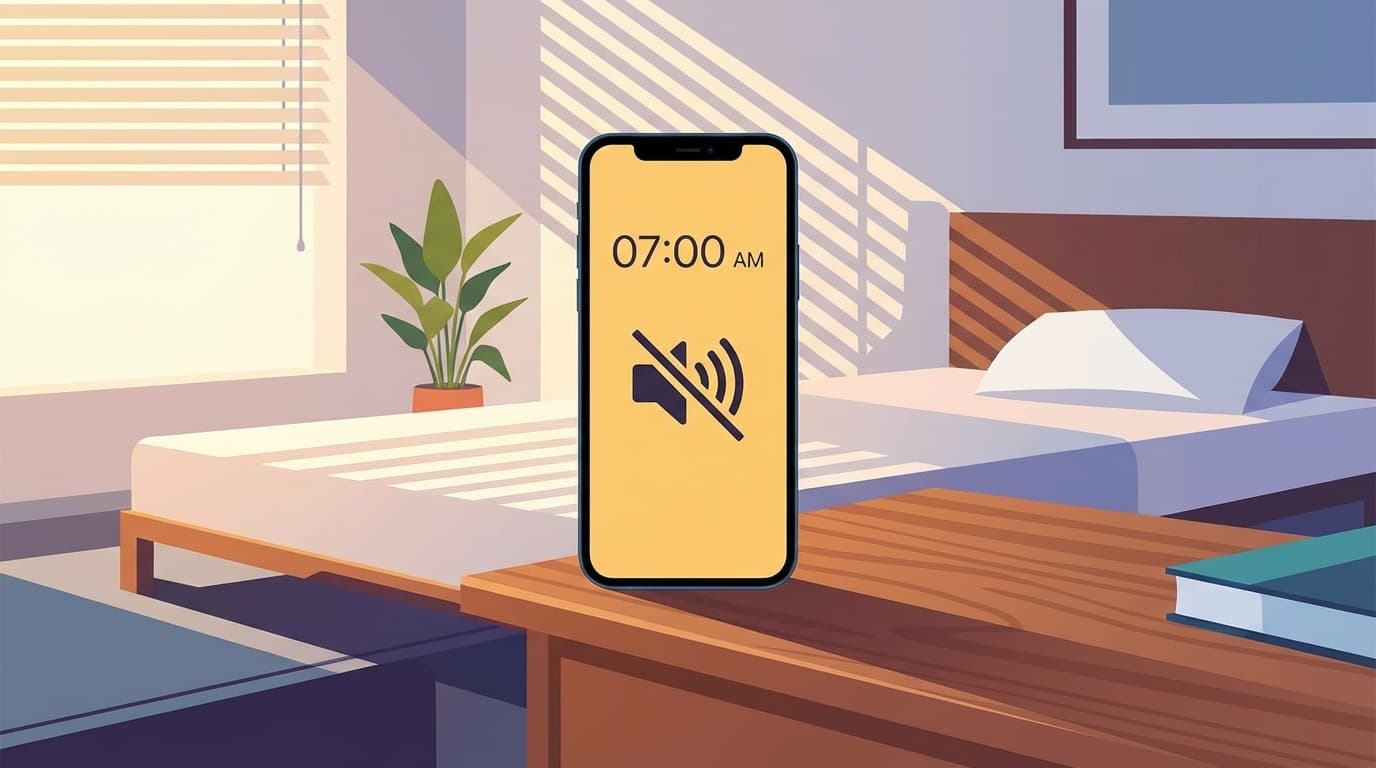
"I set the alarm, but it didn't go off!" "Even though the volume was set to max, there was no sound!"—You're not the only one who has a problem with your iPhone's alarm not going off. Apple officially acknowledged this problem in May 2024, and similar reports have been occurring one after another after updating to iOS 26.
In this article, based on the latest information as of March 2026, we will explain in an easy-to-understand manner the 7 reasons why the iPhone alarm does not go off and the specific solutions for each. We will also introduce "insurance" techniques to prevent oversleeping and being late, so be sure to check it out until the end.
Cause 1: Alarm sound is set to "None"
This is surprisingly common. If the sound is set to None on the alarm edit screen, no sound will be heard no matter how high the volume is turned up. Only vibration or complete silence.
Steps to check and take action:
- Open the Clock app and tap the Alarm tab
- Tap the alarm that does not sound to open the "Edit" screen
- Tap "Sound" and choose a ringtone other than "None"
- Tap "Save" in the top right
Roughly speaking, No sound = same as turning off the alarm clock. Let's check here first.
Cause 2: The volume of "ringtone and notification sound" is too low
There are two types of volume on iPhone: media volume (video/music) and ringtone/notification volume (phone/alarm). The alarm volume is linked to the latter, so if the ringtone volume is zero, the alarm will also be silent.
Steps to check and take action:
- Open "Settings" → "Sounds and Haptics"
- Drag the "Ringtones and Notifications" slider to the right to increase the volume
- If "Change with buttons" is turned on, please note that the volume button on the side of the device will also change the ringtone volume
In other words, even if you increase the volume of YouTube, the volume of the alarm is different. The key is to check Settings → Sound and Haptic.
Cause 3: Sound is being output to Bluetooth earphones/speakers
If wireless earphones or Bluetooth speakers are still connected to your iPhone, the alarm sound may be played from there. Even though I take off my earphones and put them on my bedside, they are actually still connected...
According to Official Apple Support, if you have headphones connected, the alarm will be played from both the built-in speakers and the headphones. However, in the case of Bluetooth devices, the behavior may differ depending on the pairing status and power status of the device.
Workaround:
- Open Control Center and Turn off Bluetooth before going to bed
- Or check the connected devices in "Settings" → "Bluetooth" and disconnect unnecessary ones
Cause 4: The alarm volume is automatically lowered by the "screen gaze recognition function"
iPhone X and later models equipped with Face ID have a function called "screen gaze recognition function". If this is turned on, the app will determine that the user has noticed the alarm and automatically lower the volume just by looking at the iPhone screen the moment the alarm sounds.
One of the reasons why I feel like my alarm didn't go off is because when I glance at the screen while half asleep, the sound goes down and I go back to sleep.
Workaround:
- Open "Settings" → "Face ID & Passcode"
- Enter passcode
- Turn off the "screen gaze recognition function"
Even if you turn off this setting, you can still unlock Face ID without any problems. If you are concerned about the phenomenon where the alarm volume automatically decreases, please try this.
Cause 5: Effect of concentration mode (do not sleep mode)
"Concentration mode" installed in iOS 15 or later. I think many people use Do Not Disturb/Sleep Mode, but there is a pitfall.
The alarm of Apple's genuine "Clock" app will sound without any problem even in concentration mode. However, if you are using a third-party alarm app downloaded from the App Store, sounds and notifications will be blocked unless you add the app to the "Allow notifications" list in Do Not Disturb mode.
Workaround:
- "Settings" → "Concentration Mode" → Select the mode you are using (e.g. sleep)
- Tap "Allowed notifications" → "App"
- Add the alarm app you are using
In short, If it's a genuine "clock" app, concentration mode doesn't matter. Only those using third-party apps need to be careful.
Cause 6: Vibration is disabled in standby mode
StandBy added in iOS 17 is a convenient feature that displays the clock and photos when you place your charging iPhone horizontally. However, Apple's official documentation states that when using standby, alarm vibration (haptic) is disabled.
There is a sound, but for people who are sensitive to vibrations, this may cause them to feel that the sound does not sound.
Workaround:
- On days when you want to be sure to wake up, charge your iPhone in portrait orientation instead of using standby mode
- Or turn the volume up high
Cause 7: iOS 26 bug (Apple official bug)
In May 2024, Apple officially acknowledged that there is indeed a bug that prevents iPhone alarms from going off. After that, alarm-related interface problems were fixed in iOS 26.1 (released in October 2025), but even with iOS 26.2 as of March 2026, some users continue to report that the alarm becomes silent or does not ring on time.
Workaround:
- Update to the latest version in ``Settings'' → ``General'' → ``Software Update''
- Restart your iPhone (long press the power button + volume button → slide to power off → power on again)
- Delete all existing alarms in the Clock app and create new ones
- If the problem still persists, try "Settings" → "General" → "Transfer or Reset iPhone" → "Reset All Settings" (data will not be deleted)
3 "insurance" techniques to prevent oversleeping
Sometimes iOS bugs are beyond your control. For those days when you absolutely can't oversleep, it's a good idea to have the following "insurance" in place.
- Set multiple alarms one to two minutes apart: Even if one doesn't go off, you're more likely to be woken up by the next one
- Set an alarm on another device too: your old phone, smart speaker (Amazon Echo, Google Nest), physical alarm clock, etc. Risk diversification is important
- Use regular alarms instead of "bedtime": Health app's "sleep schedule" is useful, but there are reports that regular alarms have more stable behavior
FAQ
Does the iPhone alarm sound even in silent mode?
Yes, it will ring. Even if you turn on the iPhone's mute switch (switch on the left side of the device), the genuine "Clock" app's alarm will sound as usual. Silent mode only mutes ringtones and notification sounds, and does not affect alarms.
Does the alarm sound even in sleep mode (concentration mode)?
The genuine "clock" app's alarm sounds even in sleep mode or sleep mode. However, third-party alarm apps will be blocked unless you add them to your Do Not Disturb notification settings.
Is there a way to change just the alarm volume?
You can change it with the slider in "Settings" → "Sounds and Haptics" → "Ringtones and Notifications". If you turn off "Change with buttons", the alarm volume will not change even if you press the volume button while watching a video, which prevents the volume from dropping unexpectedly.
If I have an Apple Watch, am I sure that the alarm will go off?
Apple Watch notifies you of alarms by vibration (haptic feedback) on your wrist, so it is effective as insurance in case the iPhone itself does not produce a sound. However, the alarm on the Apple Watch itself and the alarm on the iPhone are independent, so it is recommended to set them on both.
After updating to iOS 26, the alarm no longer sounds. Should I downgrade?
Downgrading iOS is not officially supported by Apple and is not recommended. First, try the solutions in this article (re-creating the alarm, resetting settings, etc.), and if the problem still persists, it is safe to contact Apple Support.
References
- How to set and change alarms on your iPhone — Apple Support
- Set an alarm in Clock on iPhone — Apple Support
- iPhone alarm sound not playing on iOS 26 — Apple Community
- How to fix iPhone alarms not going off in 2025 — AppleInsider, January 2025
- How to avoid the iPhone's notorious 'silent alarm' bug — Popular Science