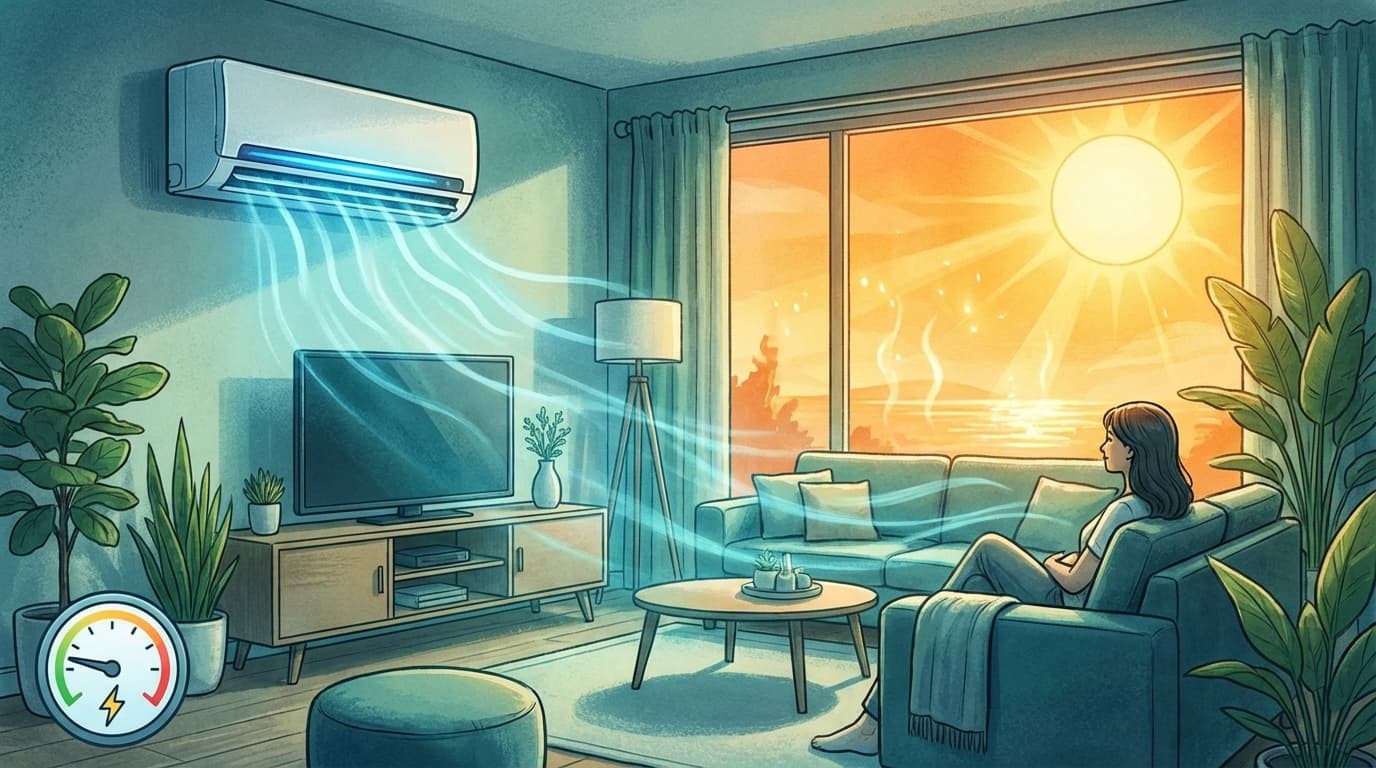
Is it true that "leaving it on is cheaper"?
You've probably heard that it's cheaper to keep your air conditioner on than to turn it off frequently.
In conclusion, this is "conditionally true".
Air conditioners use the most electricity when cooling (warming) a room to the set temperature. In other words, if you turn it on and off frequently, you end up repeating "full power operation → reaching the set temperature" each time, and as a result, you consume a lot of electricity.
However, there are conditions for this.
Case where it is advantageous to leave it on
If you're going out for about 30 minutes to an hour
It's better to leave it on if you're going to the convenience store or shopping at the local supermarket. It costs more electricity to restart the machine and cool the room again when you get home.
During the hot part of the day (when using air conditioning)
During the daytime when the outside temperature is high, the room temperature rises quickly when you turn off the unit, and a tremendous amount of electricity is used when you restart it. According to Daikin's experiment, it was about 35 yen cheaper to leave it on during the day (9:00-18:00).
Case where it is better to delete
You will be out for more than 2 hours
If you are going out for a long time, turn it off. It's a waste to keep cooling a room with no one around.
At night or while sleeping (depending on the season)
In seasons where it gets cooler at night, such as spring or autumn, it is better to turn it off with a timer. However, on tropical nights in midsummer, we recommend leaving it on for your health.
Highly insulated houses
Modern highly airtight and highly insulated houses do not allow the room temperature to drop easily, so once they cool down, they can be kept for a long time even if you turn them off. In this case, it is easier to save money by erasing them frequently.
5 ways to lower your electricity bill
This is actually more effective than the ON/OFF problem.
1. Change the temperature setting by 1℃
Increasing the air conditioner by 1℃ will save about 10% of electricity. 28℃ is recommended, but if it's hot, 27℃ is also effective.
2. Clean the filter
If the filter is clogged with dust, efficiency will decrease. Cleaning once every two weeks saves approximately 5-10% of electricity. Just vacuum it up.
3. Using a circulator together
If you use a circulator to circulate air from the air conditioner throughout the room, the perceived temperature will drop by about 2℃. The set temperature can be raised, resulting in energy savings.
4. Leave space around the outdoor unit
Are there any objects placed in front of the outdoor unit? When heat dissipation deteriorates, efficiency drops dramatically. Leave at least 20cm of space around it.
5. Use blackout curtains
Heat from windows is the biggest factor in raising room temperature. Simply blocking sunlight with blackout curtains or insulation film can significantly reduce the load on your air conditioner.
FAQ
Will the air conditioner be easily damaged if left on?
Modern air conditioners are designed to operate continuously for 24 hours, so they won't break easily if left on. However, if you skip filter cleaning, the risk of failure increases.
How much will the electricity cost if you leave it on for a month?
It depends on the model and the size of the room, but if you keep the air conditioner on for 6 to 8 tatami mats (set at 28℃), it will cost approximately 4,000 to 7,000 yen a month.
Is it the same for heating?
The basic idea is the same. However, heating uses more electricity than air conditioning, so the difference between leaving it on and turning it off frequently is likely to be large. If you are going out for less than 30 minutes, we recommend leaving it on.
References
- Leave-on experiment — Daikin
- Home energy saving (air conditioning) — Agency for Natural Resources and Energy