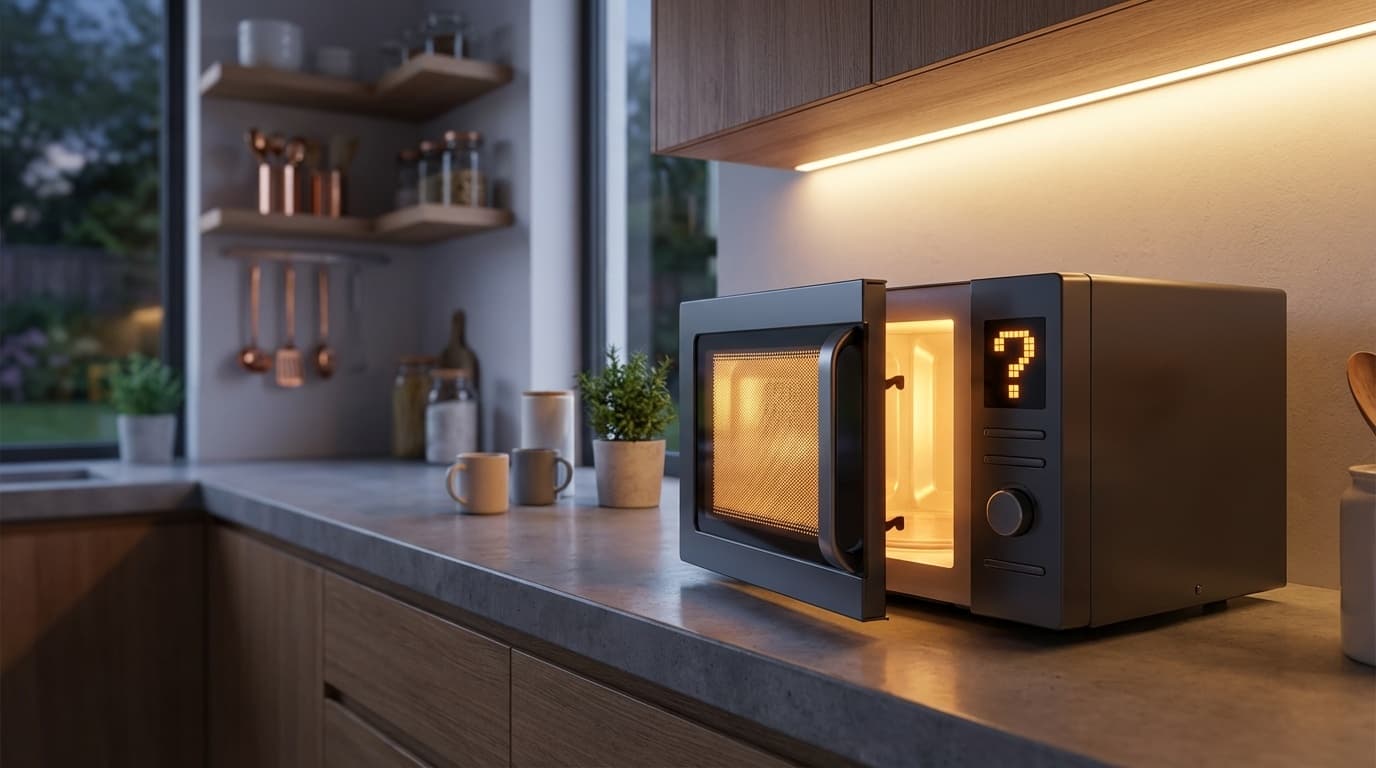
"The microwave doesn't turn on when I press start" or "It doesn't warm up at all even though I tried to heat it up" - As home appliances are used every day, it can be quite troublesome when something suddenly goes wrong.
Actually, many of the reasons why a microwave oven does not work or heat up are simple things that you can check yourself. On the other hand, there are cases where it can be dangerous if left untreated, such as sparks or strange smells, so be careful.
In this article, based on information as of March 2026, we will provide an easy-to-understand explanation of the six reasons why your microwave oven won't work or heat up, what you can do about it yourself, and the criteria for deciding whether to repair or replace.
Check first! 6 reasons why the microwave oven does not work or heat up
Microwave oven problems can be broadly divided into two types: those that don't work at all, and those that work but don't warm up. Each cause is different, so let's check them one by one.
Cause 1: Power supply related problems (outlet/breaker)
This is surprisingly common. This is likely due to the power plug not being plugged in properly or the breaker being tripped.
Since a microwave oven is a home appliance that consumes a large amount of power, it is basic to connect it alone to a wall outlet with a rating of 15A or higher and 100V AC. According to Panasonic's official FAQ, extension cords and octopus wiring are not recommended as they can cause power shortages.
Solution: Unplug the power outlet and plug it back into the wall outlet directly. Also check that the breaker has not tripped.
Cause 2: Door is not closed properly
Microwave ovens have a safety device (door switch) that prevents them from operating unless the door is completely closed.
If food particles and dirt accumulate on the latch of the door, it may appear that the door is closed, but it may actually be floating a little.
Solution:Clean the edges and latch of the door with a damp cloth. Close it firmly until you hear a click, then try again.
Cause 3: Dirt inside the refrigerator (No. 1 cause of difficulty in heating)
If the oven moves but does not heat up, the first thing to suspect is dirt inside the oven. If oil splatter or food particles are stuck to the inner walls, the transmission of microwaves (radio waves that heat food) will be affected.
Haier's official website also lists dirt inside the refrigerator as a major factor in reducing heating efficiency.
How to deal with it:An easy method is to fill a heat-resistant container with water, heat it in the microwave for about 3 minutes, let the steam lift the dirt, and then wipe it off. It is even more effective to use baking soda water (1 tablespoon of baking soda in 200 ml of water).
Cause 4: The container used was not microwave safe
If you put a metal container or aluminum foil in the food, the microwaves will be reflected and will not reach the food, meaning it won't warm up. In the worst case, sparks may appear.
Toshiba's official FAQ According to Toshiba's official FAQ, containers made of metal or metal processed can cause sparks to occur when they come into contact with the internal walls of the refrigerator.
How to deal with it:Use heat-resistant glass, ceramic, silicone, or plastic containers marked "microwave safe." Absolutely no metal or aluminum foil. Check the label on the container to see if it is OK to wrap.
Cause 5: Magnetron deterioration (the main cause of not getting warm)
If the device still does not warm up even after checking all four of the above, Deterioration of the magnetron is suspected. The magnetron is the core part of a microwave oven that generates microwaves.
According to Looop Denki's official website, the lifespan of a magnetron is approximately 2,000 hours. For households that use it for 30 minutes every day, the recommended lifespan is about 10 years.
When the magnetron becomes weak, you may experience symptoms such as ``It heats up, but it takes longer than before'' and ``It's very uneven.'' You cannot repair this yourself.
What to do:Please refer to the "Repair or Replacement Judgment Criteria" below.
Cause 6: Internal board or sensor failure
If the button does not respond when pressed, the display panel disappears, or the program stops midway, the control board or sensor may be malfunctioning.
Sharp's Troubleshooting Guide advises you to first check that the power plug is plugged in and check the door if the power does not turn on, and if the problem persists, it recommends consulting for repair.
Workaround:Try "resetting" by unplugging the power plug, waiting 10 minutes, and then plugging it back in. If the problem still does not improve, it is necessary to consider repair or replacement.
Be careful of sparks, strange noises, and burning smells! Cases in which use should be stopped immediately
Even if your microwave is malfunctioning, if you experience any of the following symptoms, please stop using it immediately. Continuing to use the product may cause fire or smoke.
- Sparks inside the oven: If sparks appear even though there is no metal in the oven, the cause is peeling of the coating on the inner wall or carbonization of dirt. Panasonic's official FAQ advises you to immediately stop using it and unplug the power plug
- Unusual noises such as rasping and buzzing: Possibility of damage to the turntable or distortion of the fan shaft
- Burning odor/smoke: Possibility of short circuit in internal wiring or burnout of parts
- Does not stop even when door is opened: Danger of microwave leakage due to safety device failure
If any of these symptoms occur, unplug the power plug and contact the manufacturer's repair center. Never disassemble it yourself. There is ahigh voltage capacitor inside the microwave oven, which poses a risk of electric shock even after the power is turned off.
Which is more economical: repair or replacement? Explaining the judgment criteria
If you're unsure, "I think it's still usable, but should I repair it or buy a new one?" Consider the following three points.
Point 1: How many years have passed since purchase
According to Panasonic's official website, the standard design lifespan of a microwave oven is approximately 10 years. In addition, the manufacturer's retention period for repair parts is 8 years from the end of production. After this time, you may not be able to obtain repair parts in the first place.
| Years of Use | Recommended | Reason |
|---|---|---|
| Less than 5 years old | Repair | Parts available. Repair costs are also relatively low |
| 5 to 8 years | On a case-by-case basis | Decision by comparing repair cost and new price |
| 8 years or more | Replacement | There is a high possibility that parts are not available. Other parts have also deteriorated |
Point 2: Know the average repair cost
Microwave oven repair costs vary greatly depending on the symptoms. This is roughly the market price.
- Replacement of door switch: Around 5,000 to 8,000 yen
- Magnetron replacement: Around 10,000 to 18,000 yen
- Replacement of board: Around 8,000 to 15,000 yen
- Travel expenses/diagnosis fees: 2,000 to 5,000 yen separately
You can buy a new single-function microwave oven for around 10,000 yen, so if the repair cost is more than half of the original price, it is better to buy a new one.
Point 3: Recent microwave ovens have improved energy-saving performance
Compared to 10 years ago, many of the latest microwave oven models have improved power consumption. The longer you use your appliance, the more the difference in electricity costs will add up, so it may be more economical to upgrade to a new model than to repair and continue using your old model.
5 tips to make your microwave last longer
Once you have bought a new microwave oven, you want to use it for as long as possible. Haier official website and Japanet's official guide.
- Wipe it quickly after each use: Do not leave oil splatters or food particles behind. If you wipe it while the steam remains, it will come off easily
- Connect alone to a wall outlet: Avoid extension cords and cordless wiring. Lack of power puts stress on parts
- Do not fire dry: Running the magnetron without anything in it will cause serious damage to the magnetron. Be especially careful of children's mischief
- Do not place anything on top: Blocking the heat exhaust vent will increase the internal temperature and accelerate the deterioration of parts
- Clean the inside of the refrigerator once a week: Recommended method is to fill with steam using baking soda water and microwave heating before wiping.
How to properly dispose of a microwave oven
If you decide to buy a new one, you will also need to dispose of your old microwave. Microwave ovens can be disposed of as bulky waste (small home appliances), but rules vary depending on the municipality where you live.
- Municipal bulky waste collection: Many municipalities require a processing ticket of around 200 to 500 yen. Advance reservations are often required
- Trade-in/pick-up at a home appliance retailer: You can often pick up your new microwave at the store where you purchased it. Free ~ around 1,000 yen
- Small home appliance collection box: Some local governments offer free collection of items that fit into the slot (microwaves often cannot)
- Flea market app/recycle shop: If it still works, you may be able to sell it. But be careful about shipping charges
Please note that microwave ovens are not subject to the Home Appliance Recycling Law, so there are no recycling fees like TVs or refrigerators.
FAQ
How many years does a microwave oven last?
Generally, about 10 years is the standard. The lifespan of the magnetron, which is the core component, is approximately 2,000 hours, and if used for 30 minutes every day, it will reach the end of its lifespan in approximately 10 years. The manufacturer's maintenance period for repair parts is 8 years from the end of production.
If sparks appear in the microwave, can you no longer use it?
Please stop using it immediately and unplug the power plug. If you put a metal container in it, you may be able to use it if you remove it, but if sparks come out even though there is nothing inside, an internal malfunction is suspected. Consult with the manufacturer's repair center.
Which is more economical, repair or replacement?
If it has been less than 5 years since purchase, we recommend repair. If it's more than 8 years old, it's often cheaper to replace it. If the repair cost exceeds half of the unit price, consider replacing it.
What should you try first when the microwave won't heat up?
First, check that the power plug is inserted, the door is closed, the inside of the refrigerator is dirty, and the material of the container used. If these do not solve the problem, the magnetron may have deteriorated or the internal board may have failed.
Is there a recycling fee for disposing of an old microwave oven?
Microwave ovens are not subject to the Home Appliance Recycling Law, so there is no recycling fee. The most common methods of disposal are bulky garbage collection at local governments (about 200 to 500 yen) or collection at electronics retailers.
References
- Food won't heat up in the microwave! ? Two things you should try in such a case — Haier official
- How long does a microwave oven last? Timing of replacement and tips to make it last longer — Panasonic official
- How many years does a microwave oven last? Signs that tell you the lifespan and how to make it last longer — Looop Denki Official
- When sparks come from the microwave — Panasonic official FAQ
- Power does not turn on/display does not come on Trouble diagnosis navigation — Sharp official
- Sparks appeared when heating in the microwave — Toshiba Lifestyle Official FAQ
- How many years does a microwave oven last? Warning signs of breakage and sparks/abnormal noises — Japanet Official