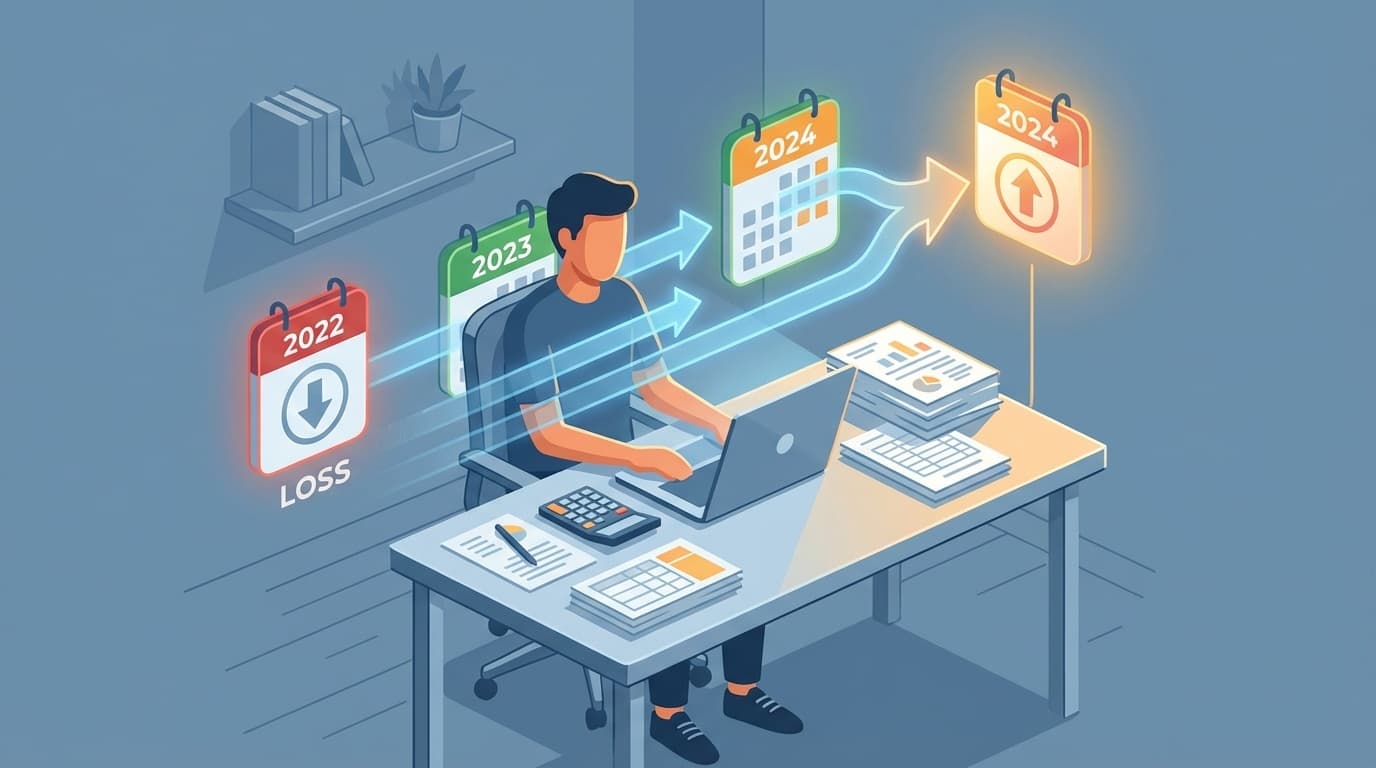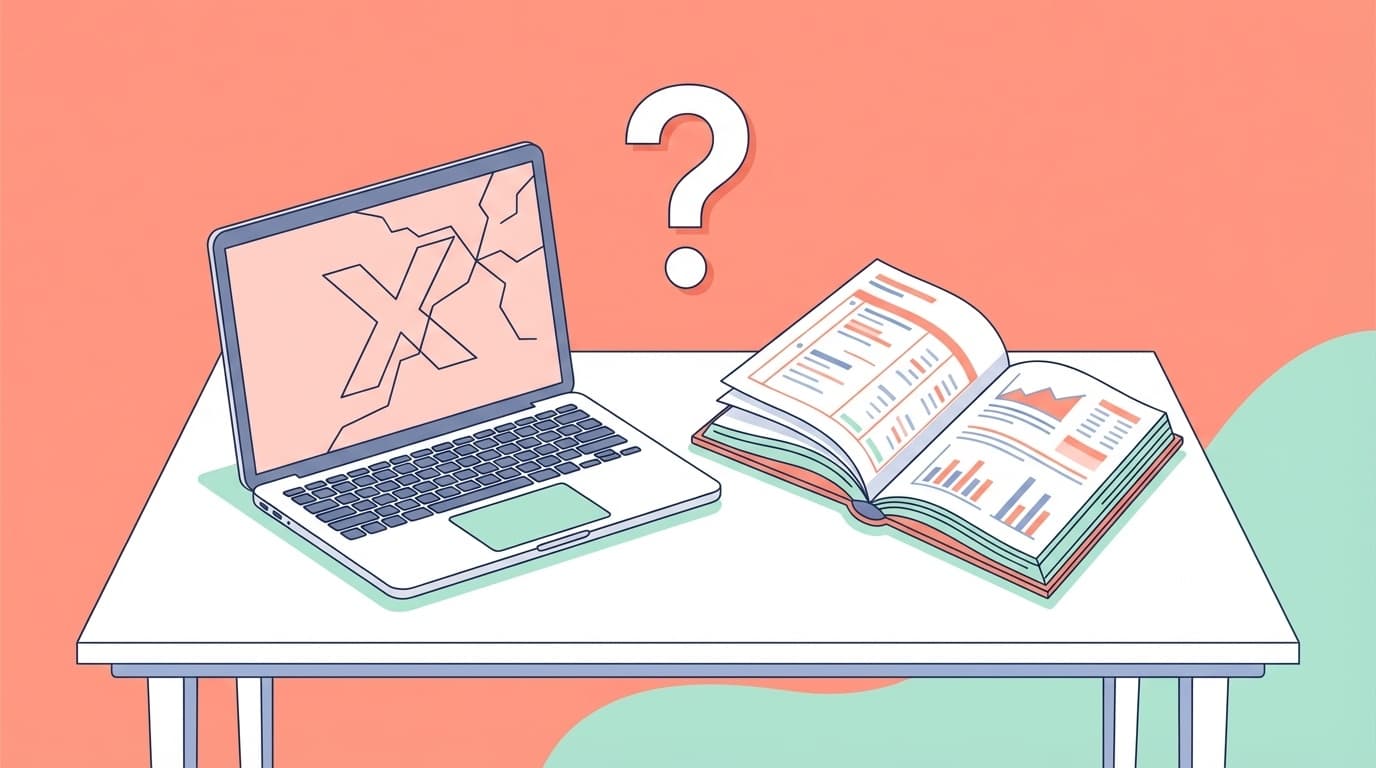
"The computer I was using for work broke, so I got rid of it. But when I looked at the ledger when filing my tax return, it still remained as an asset... What should I do about it?"
Actually, this is a point where sole proprietors and freelancers often have trouble when filing tax returns. Items recorded as fixed assets do not disappear from the books just by physically throwing them away. If you don't do the accounting process of "retirement," it will remain in your books forever.
In this article, we will explain everything about what is fixed asset retirement, how to write a specific journal entry, and the operating procedures for freee and money forward. I see people on social media saying, ``I didn't know how to do journal entry, so I asked an AI.'' However, if you read this article, you will be able to easily do it yourself without having to ask an AI.
What exactly is "removal"? How is it different from disposal?
First, let's organize the terminology. If this is ambiguous, the journal entry will be confusing.
| Term | Meaning | Specific examples |
|---|---|---|
| Disposal | Physically throwing away things | Sending your broken PC to a recycling company |
| Retirement | Accounting process of erasing assets on the ledger | Excluding the PC from the fixed asset ledger and making a journal entry |
| Selling | Selling to a third party and letting it go | Selling a used PC on Mercari |
The point is that "disposal" and "removal" are performed as a set. When you throw something away (disposal), you also erase it from your books (removal). If you don't do these two things as a set, "assets that no longer exist" will remain on your books forever.
Conversely, you can also dispose of even if you physically still have it but no longer use it for business. This is called ``removal with appearance''. However, there is a risk that a tax audit will point out that you are not really using it, so it is safest to get rid of it at the same time as disposal.
Write the journal entry for retirement like this! Explanation by pattern
The way you write a journal entry for retirement changes depending on how far the depreciation of the asset has progressed. Here are three patterns most commonly encountered by sole proprietors.
Pattern 1: Retire assets that have been depreciated (memorandum value of 1 yen remains)
For assets that have been depreciated, only 1 yen remains on the books. This is called the memorandum value. The journal entry in this case is very simple.
| Debit | Amount | Credit | Amount |
|---|---|---|---|
| Miscellaneous expenses (or loss on disposal of fixed assets) | 1 yen | Tools, furniture and equipment | 1 yen |
Since it is only 1 yen, the account item can be "Miscellaneous expenses". There is no need to go out of your way to use “loss on retirement of fixed assets.”
Pattern 2: Retirement during depreciation (book value still remains)
For example, let's consider a case where you bought a computer for 200,000 yen in 2024 (useful life is 4 years, straight-line method) and discarded it midway through 2026.
Calculation flow:
- Acquisition price: 200,000 yen
- Annual depreciation cost: 200,000 yen × 0.250 = 50,000 yen
- Amortized in 2 years of 2024 and 2025: 100,000 yen
- Interim depreciation expense for 2026 (from January to the month of retirement): For example, if retired in June, 50,000 yen × 6/12 = 25,000 yen
- Book value (unamortized balance): 200,000 yen − 100,000 yen − 25,000 yen = 75,000 yen
The journal entry will be as follows (for direct method):
| Debit | Amount | Credit | Amount |
|---|---|---|---|
| Depreciation cost | 25,000 yen | Tools, furniture and equipment | 100,000 yen |
| Loss on disposal of fixed assets | 75,000 yen |
Here, the loss on retirement of fixed assets of 75,000 yen is an expense. In other words, if you retire an asset that has not yet been depreciated, the remaining book value can be expensed at once. This is a good point to know.
Pattern 3: When disposal costs money
If there is a recycling fee for a computer or a cost for removing large equipment, those costs will also be included in the loss on disposal.
| Debit | Amount | Credit | Amount |
|---|---|---|---|
| Loss on retirement of fixed assets | 75,000 yen | Tools, furniture and equipment | 75,000 yen |
| Loss on disposal of fixed assets | 3,000 yen | Cash (or business loan) | 3,000 yen |
Disposal costs such as recycling fees can also be recorded as expenses, so be sure to keep your receipts.
Operating instructions for each accounting software (freee/money forward)
For those who say, ``I know how to write journal entries, but how do I do it with accounting software?'' I will explain the operations in major accounting software.
For freee accounting
- Open “Fixed Asset Ledger”: Select “Settlement → Fixed Asset Ledger” from the menu
- Select target asset: Click the row of the asset you want to retire
- Select "Process" → "Retirement": Enter the retirement date (actual date of disposal)
- Check "Create a journal entry for retirement": If you enter this, a journal entry will be automatically created
- Save: Check the automatically recorded retirement journal in the journal
Note: If you retire on a date during the term, you may need to cancel the monthly closing. Also, in freee, "removal" and "deletion" are different things. If you select "Delete", the fixed assets and depreciation journal entries will be deleted, so be sure to select "Retire".
For Money Forward cloud tax return
- Open "Fixed Asset Ledger": Select "Settlement/Return → Fixed Asset Ledger" from the menu
- Click "Edit" for the target asset
- Select the "Sale/Retirement" tab: Enter the retirement date and reason for retirement
- Check automatic creation of journal entries: Check if the retirement loss account is correct
- Save and review journal entry
For Money Forward, you can choose between the direct method and the indirect method. The direct method is generally used for sole proprietorships, so unless there is a particular reason, the direct method is OK.
In the case of Yayoi accounting (Yayoi blue tax return)
- Open “Fixed Asset List”
- Select the target asset and click "Retire"
- Enter the retirement date and reason for retirement
- Journal entries are automatically created
The basic flow is the same for all accounting software: ``Fixed asset ledger → Retirement → Automatic creation of journal entries''.
"Evidence" that must be left when disposing of a property
When asked in a tax audit, "Did you really retire?", journal entries alone are not proof. Be sure to keep documents proving the fact of disposal.
- Certificate of Disposal: Document issued by recycler or disposal company
- Manifest (industrial waste management form): When disposed of as industrial waste
- Recycling ticket copy: Issued when recycling a computer
- Photos at the time of disposal: It is safe to take photos before disposal
- Receipt of disposal costs: Provides evidence if costs are incurred
Particularly in the case of a computer, if it has the PC Recycling Mark, the manufacturer can collect it for free, but it is better to save the application confirmation email and receipt confirmation.
I forgot to remove it! What to do with the past?
There are surprisingly many cases where people say, ``I threw something away last year, but I forgot to get rid of it...'' What should I do in this case?
Conclusion: It is OK if you dispose of it in the year you notice it.
However, there are some points to note.
- Retirement loss can be expensed in the year in which it was actually disposed of. Since it is originally an expense in the year of disposal, it may be necessary to amend your past tax return (request for correction).
- Request for correction within 5 years: Correction cannot be made after 5 years
- If the amount is small, it is unlikely to be a practical problem even if it is processed in the current fiscal year: If the memorandum value is only 1 yen, the tax office will generally not point it out
If you are unsure, we recommend that you consult a tax office for free consultation or check with a tax accountant.
Frequently Asked Questions (FAQ)
Q. Do I need to dispose of computers that cost less than 100,000 yen?
A. If you purchased it for less than 100,000 yen, it should be expensed as a "consumables expense", so it will not be listed in the fixed asset ledger. Therefore, there is no need to make a journal entry for retirement. Only those recorded as fixed assets (of 100,000 yen or more) need to be disposed of.
Q. What happens if I give my broken computer to a family member?
A. If business assets are converted to personal use, they are treated as ``household consumption''. The journal entry will be ``Owner's loan/Tools, equipment, and equipment,'' and the book value will be transferred to Employer's loan. It will not be a loss on retirement, but it will disappear from the books.
Q. How will the consumption tax be handled if it is retired?
A. In the case of disposal due to disposal, consumption tax is not levied. Since no consideration has been received, it is not subject to tax. However, please note that if you sell it, it will be a taxable sale. Tax-exempt businesses do not need to be particularly concerned.
Q. What if I dispose of a lump-sum depreciable asset (less than 200,000 yen) midway?
A. As a general rule, for lump-sum depreciation assets (if 3-year equal depreciation is selected), even if they are disposed of halfway, the 3-year equal depreciation continues. It is not possible to record a retirement loss in the middle of the process. However, if it is made into a lump-sum expense under the special case for small-value depreciable assets (less than 300,000 yen) in the blue tax return, it will not be recorded in the fixed asset ledger in the first place, so there is no need for retirement processing.
Q. Which is more advantageous, retirement or sale?
A. It depends on a case-by-case basis, but it is often more tax efficient to retire assets with a remaining book value. When a property is sold, the sale proceeds become income, but when it is retired, the remaining book value becomes an expense (loss on disposal). However, it would be a waste to throw away something that can be sold, so make a decision by comparing the sale proceeds with the tax savings.
References
- Retire fixed assets – freee Help Center
- What is the retirement of fixed assets in depreciation? Also explains the difference between disposal and disposal! – Money Forward Cloud Accounting
- What is loss on retirement of fixed assets? Explanation of target fixed assets and journal entry methods – Yayoi Co., Ltd.
- Accounting treatment when disposing of fixed assets [Depreciation expenses for personal business] – Self-employment encyclopedia
- What happens if you forget to retire fixed assets? Explaining journal entry methods and countermeasures – Money Forward Cloud Accounting