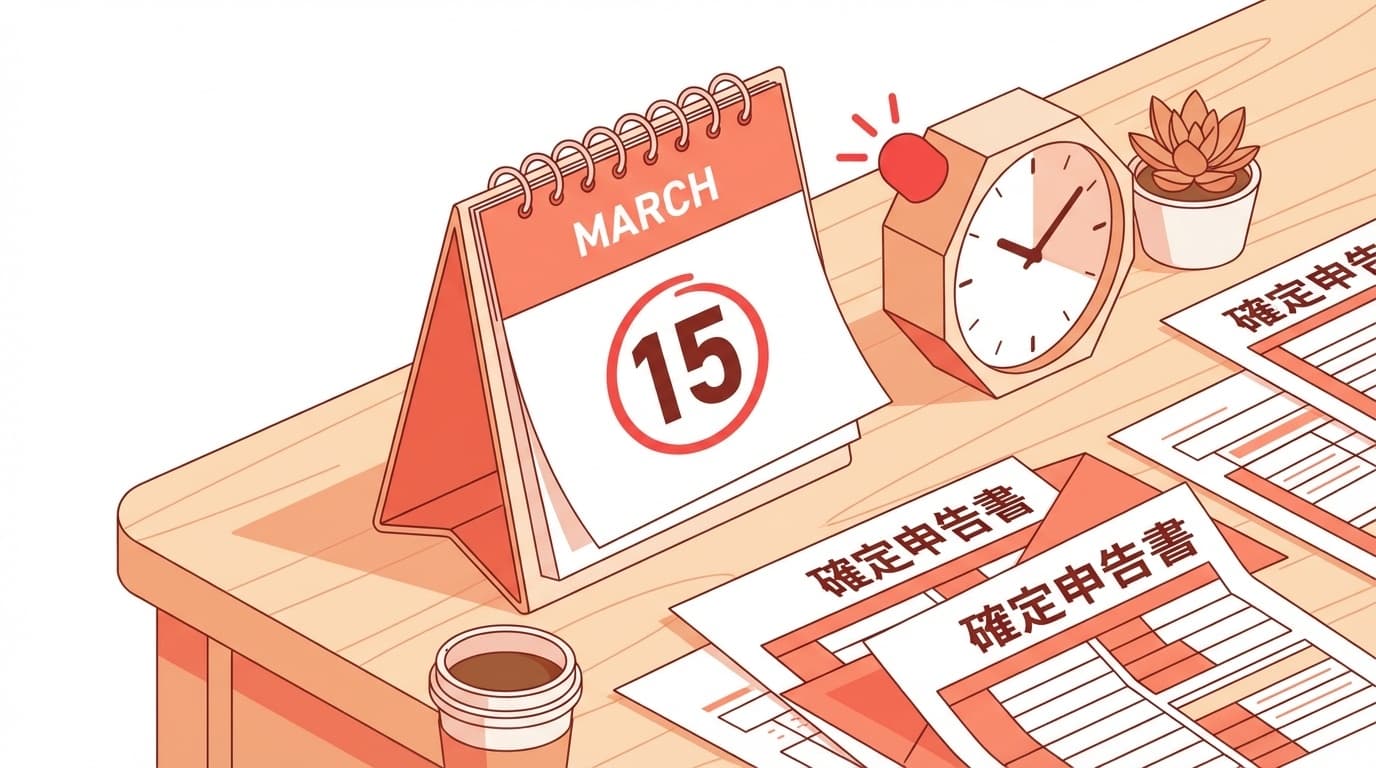
“Oh no, I haven’t even finished getting my tax return ready…” “I might not make the deadline.” Every March, social media fills up with posts like these. For 2025 income, the deadline for filing Japan’s income tax return is Monday, March 16, 2026. But even if you miss it, Japan has a system called a late filing, so the one thing you absolutely shouldn’t do is ignore it.
This article explains how the penalties work if you miss the tax return deadline, plus four ways to keep any extra tax as low as possible. The information is based on the latest details available as of March 2026.
What Is a “Late Filing,” and What Happens If You Do Nothing?
Tax returns have a legally set deadline, known as the statutory filing deadline. For 2025 income, the deadline is Monday, March 16, 2026. Filing even one day after that deadline is considered a late filing.
You might wonder, “If I’m late, does that mean I can’t file anymore?” The answer is no. The tax office will still accept your return after the deadline. However, the later you file, the more likely you are to face penalties, meaning additional tax.
On the other hand, if you think, “Well, I’m already late,” and leave it alone, you could end up facing a tax audit, and the penalties can grow much larger. Even if you’re late, the basic rule is simple: file voluntarily as soon as you can.
The Two Penalties That Can Apply to Late Filing
If you miss the deadline, the following two charges may be added on top of the tax you originally owed.
1. Non-Filing Penalty Tax
This is the penalty for “not filing by the deadline.” According to the National Tax Agency’s No. 2024, “When You Forget to File a Final Tax Return”, the rates are as follows.
- If you file voluntarily before a tax audit: 5% of the tax due
- If you file after a tax audit begins: 15% of the tax due, with 20% applied to the portion over ¥500,000 and 30% to the portion over ¥3 million
In other words, if you file early on your own, the penalty can stay at 5%. But if the tax office points it out first, it jumps to 15% or more. That’s a big difference.
2. Delinquent Tax
This is similar to interest charged for “not paying your tax by the deadline.” According to the National Tax Agency’s method for calculating delinquent tax, the 2026 rates are as follows.
- Within two months after the day following the payment deadline: 2.4% per year
- For the portion after two months: 8.7% per year
Put simply, if you’re within two months, the interest rate is 2.4% per year. For example, if you owe ¥100,000 and pay one month late, the delinquent tax is only around ¥200. Honestly, that amount isn’t huge. The real risk is letting it sit for months.
Step 1: File Within One Month and Your Non-Filing Penalty May Be Zero
This isn’t widely known, but in some cases, you won’t be charged the non-filing penalty even if you file late, as long as you meet certain conditions. The three requirements listed in the National Tax Agency’s No. 2024 are below.
- You voluntarily file the late return within one month of the statutory filing deadline
- You have paid the full amount of tax due for that late filing by the statutory payment deadline
- You haven’t been charged a non-filing penalty or heavy penalty tax in the past five years, and you haven’t used this special treatment before
In short, if “you paid the tax on time, but the paperwork was just a little late,” then filing within one month may bring the non-filing penalty down to zero.
For 2025 income, the deadline is March 16, so if you file by April 16, you may be able to use this special treatment. Just be careful: the tax itself must have been paid by March 16.
Step 2: If You’re Short on Cash, Use the Deferred Payment System
If you can file your return but don’t have enough money to pay the full tax bill, you may be able to use the deferred payment system. According to the National Tax Agency’s deferred payment notification, it works like this.
- All you need to do is enter the amount in the “deferred payment notification” section of your tax return
- If you pay at least half of the tax due by March 16, the rest can be extended until Monday, June 1, 2026
- During the deferral period, interest tax of 0.9% per year, as of 2026, applies
The interest tax is 0.9% per year, so even if you defer the remaining ¥100,000 for about two and a half months, it comes to roughly ¥190. Compared with credit card revolving payments, which are often around 15% per year, it’s dramatically cheaper.
Important note: If you use direct debit payment, the full amount is withdrawn on the debit date, so be careful when combining it with deferred payment.
Step 3: If Disaster or Illness Caused the Delay, Apply for an Individual Extension
If a disaster, hospitalization, or another unavoidable reason keeps you from filing on time, there’s a system that can extend the filing deadline itself. According to the National Tax Agency’s No. 8001, “Extension of Deadlines Due to Disaster, etc.”, you can apply using the steps below.
- Submit an “Application for Extension of Filing, Payment, and Other Deadlines Due to Disaster” to the tax office
- The district director of the tax office will set a new deadline within two months after the unavoidable reason has ended
- The application can be submitted either through e-Tax or on paper
Examples of “unavoidable reasons” include natural disasters such as earthquakes and typhoons, your own hospitalization or serious illness, and loss of accounting records due to fire or theft. Simply being busy or forgetting won’t qualify, so keep that in mind.
Step 4: File as Soon as Possible, Even If You’re Already Late
If you’ve read this far and thought, “None of these systems seem to apply to me,” don’t give up. The most important thing is to file voluntarily as soon as possible. There are three reasons.
- Delinquent tax is calculated daily: the sooner you pay, the less it costs
- Voluntary filing keeps the non-filing penalty at 5%: if a tax audit catches it first, it can be 15% or more, which is triple
- You lose the ¥650,000 blue return deduction: with a late filing, the blue return special deduction drops to a maximum of ¥100,000. That means ¥550,000 of deductions disappears, which can significantly increase your actual tax burden
The most expensive pattern is thinking, “I’m already late, so whatever.” Once you realize you’re late, do what you can from that point forward. That’s the best way to minimize penalties.
FAQ
Will the tax office scold me if I miss the filing deadline?
No, they won’t scold you. The tax office will accept late returns just like normal. That said, penalties such as the non-filing penalty tax, 5% if you file voluntarily, and delinquent tax, starting at 2.4% per year, may apply. The sooner you file, the smaller the penalties, so it’s best to submit as soon as you can.
If I’m filing for a refund, are there penalties for filing late?
No. If you’re filing a refund return, there are no penalties. Refund returns aren’t limited to the regular tax filing season from February to March. You can file any time for five years starting January 1 of the year after the eligible year. Since there’s no tax to pay, neither the non-filing penalty nor delinquent tax applies.
Can I submit through e-Tax until 11:59 p.m. on the deadline day?
Yes. With e-Tax, or electronic filing, you can submit until 11:59:59 p.m. on the deadline day. Even after the tax office counter is closed, e-Tax accepts filings late into the night. If you’re cutting it close, consider filing through e-Tax. Just keep in mind that heavy traffic can make the site harder to access, so it’s still better to send it with time to spare.
If I file late, will my blue return approval be revoked?
A single late filing usually won’t cause your blue return approval to be revoked right away. However, if you file late two years in a row, the tax office may revoke your approval. Also, with a late filing, the blue return special deduction drops from ¥650,000 to ¥100,000, which can substantially increase your tax burden.
How do I submit a late filing?
You can submit it the same way as a regular tax return: e-Tax, mail, or in person at the tax office are all fine. The forms are filled out the same way, too. No special procedure is required. If you submit after the deadline, it will automatically be handled as a late filing.
References
- No. 2024: When You Forget to File a Final Tax Return -- National Tax Agency
- How to Calculate Delinquent Tax -- National Tax Agency
- No. 8001: Extension of Deadlines Due to Disaster, etc. -- National Tax Agency
- Step 5: Deferred Payment Notification -- National Tax Agency
- When Does Filing for 2025 Income Start and End? What to Do If You Miss the Deadline -- freee