“I had almost no sales this year, so I don't have to file a tax return because I'm in the red, right?” Don't you think so?
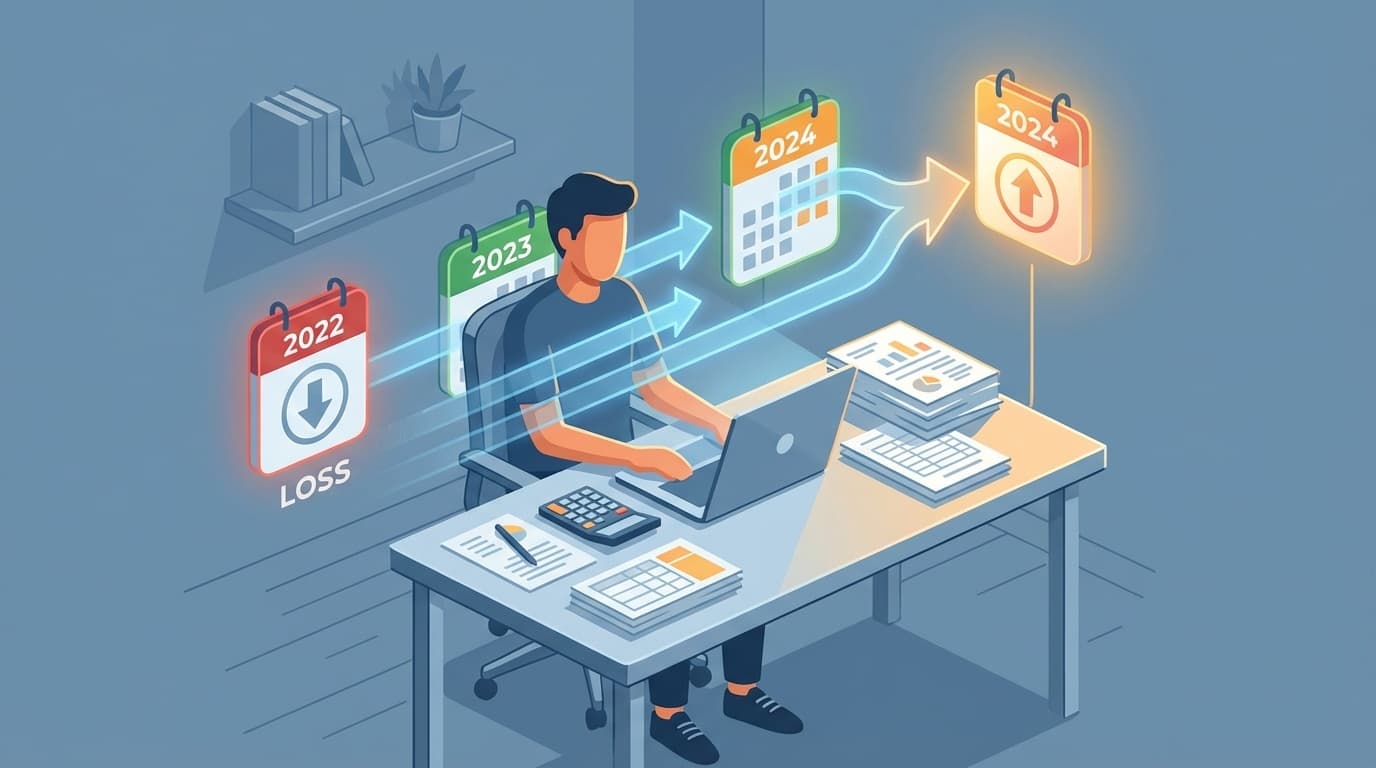
Actually, there are many cases where it is more advantageous to file a tax return when you are in the red. In particular, if you are a sole proprietor who files a blue tax return, you can use a system called ``net loss carryover deduction,'' which allows you to carry forward your deficit (net loss) from the following year for up to three years and offset it against your future surplus.
In this article, based on information as of March 2026, we will explain in an easy-to-understand manner the reasons why you should file a tax return even if you have zero sales or a deficit, the mechanism for carrying forward deductions for net losses, and the specific procedures.
Isn't it mandatory to file a tax return if you're in the red?
In conclusion, If your business income is in the red and your income tax is zero, there is no legal obligation to file a tax return. Under the Income Tax Act, ``those who have the tax to pay'' are responsible for filing the tax return, so if the deficit = zero tax payment, there is no penalty for not paying the tax.
However, "I don't have any obligation" and "I don't have to do it" are completely different things. Filing a tax return even if you have a deficit has the following benefits:
- Net loss carryover deduction allows you to subtract the deficit from the surplus from the following year (up to 3 years)
- Net loss carryback refund, which allows you to get back a portion of the income tax you paid in the previous year
- Income certificate/tax certificate can be issued (necessary for mortgage screening, etc.)
- National Health Insurance premiums are calculated correctly and may be reduced
- Taxes may be reduced by aggregating profits and losses with other income (salary income, etc.)
In other words, if you leave it alone and think, ``I don't have to spend it because it's in the red,'' you will miss out on future tax-saving opportunities. The deficit tends to be especially large in the first year of business or in years when there was a lot of investment. Carryover deductions allow you to ``save'' that deficit.
What is "net loss carryforward deduction"? Roughly explain the mechanism
The net loss carryover deduction is a system that can only be used by sole proprietorships filing blue tax returns. Roughly speaking, this means that you can reduce your income tax by offsetting this year's deficit with next year's surplus.
For example, consider the following case.
| Fiscal year | Business income | Application of carryover deduction | Taxable income |
|---|---|---|---|
| 2025 | -1 million yen (deficit) | ― | 0 yen |
| 2026 | +600,000 yen (surplus) | -600,000 yen carried forward deduction | 0 yen |
| 2027 | +800,000 yen (surplus) | -400,000 yen carried forward deduction (remaining amount) | 400,000 yen |
Even if there is a deficit of 1 million yen in 2025, it can be offset by a total surplus of 1 million yen in the following year and the year after, so There will be no income tax in 2026, and only 400,000 yen will be taxed in 2027. If you do not declare a deficit, you will be taxed in full on 600,000 yen in 2026 and 800,000 yen in 2027.
This difference is huge, isn't it? According to the National Tax Agency's "Blue Return System" explanation page, the carryover period of deductions is up to 3 years from the year following the year in which the loss occurred.
Three conditions for using carryover deduction
If you're wondering, "So anyone can use it?" That's not the case. All of the following three conditions must be met:
Condition 1: Blue tax return has been approved
You cannot carry forward deductions for net losses when filing a white tax return (with the exception of some losses). If you have not yet filed a blue tax return, please submit 'Application for Blue Tax Return Approval' to the tax office. As a general rule, the application must be submitted by March 15 of the year in which you wish to apply (for new businesses, within 2 months from the date of opening).
Condition 2: Tax return must be filed within the deadline in the year in which the deficit occurred
This is the biggest point. If you have not filed a tax return in the year in which you have a deficit, you cannot use carryover deductions. ``I didn't declare it because I was in the red'' is the most wasteful scenario. In principle, the deadline for filing a tax return is February 16th to March 15th of the following year (March 15th, 2027 for 2026).
Condition 3: Continuously filing tax returns from next year onward
In order to receive a carryover deduction, you need to continue filing your tax return uninterrupted not only for the deficit year, but also for the following years. Be careful, if you skip even a year in the middle, the losses you carry forward will disappear.
Specific procedure: How to fill out Schedule 4 of the final tax return
If you are reporting a loss in the red, in addition to the regular tax return (Tables 1 and 2), submit "Table 4 of the final tax return (for loss declaration)". Table 4 has two pages, (1) and (2).
How to write Table 4 (rough version)
- Table 4 (1): Enter the amount of losses incurred this year. Write the amount of business income deficit in the "Ordinary income" column
- Table 4 (2): Enter the details of the losses carried forward. Enter the amount in the "Loss amount to be carried forward to next year" column
- From the following year onward, in the year in which the carryover deduction is applied, it will be deducted from that year's income in the "Calculation for subtracting carried forward loss" column in Table 4 (2).
Honestly, it's a little confusing if you write it by hand. freee, Yayoi Blue Tax Return, Money Forward If you use accounting software such as Cloud Tax Return, you can automatically generate the fourth table just by entering the deficit, so you can do it without any hassle.
Also, at the National Tax Agency's Final Tax Return Creation Corner, Form 4 will be automatically created by following the on-screen instructions. The same applies when filing a tax return electronically using e-Tax.
Another weapon: Let's know about "return refund"
If carry-forward deductions are a system that ``carries deficits into the future,'' carryback refunds are a system that ``applies deficits to the past.''
If you paid income tax in the previous year with a surplus, this year's deficit will be applied to the previous year's income, and part (or all) of the income tax paid in the previous year will be refunded.
For example, if you pay income tax of 500,000 yen in 2025 and have a large deficit in 2026, "Request for income tax refund due to carryback of net loss amount along with your final tax return, you will receive the previous year's income tax back.
However, there are some caveats.
- Carry-back refund is applicable to income tax only. Does not apply to resident tax or personal business tax
- You must also have filed a blue tax return within the deadline for the previous year
- You must choose either one of the carryback refund and carryover deduction (they cannot be used together)
If you think, "I paid a lot of tax last year...", a carry-back refund may be more advantageous. Which option is more advantageous depends on your future business outlook, so if you are unsure, it is best to consult a tax accountant.
Can I use it as a side job for office workers? Key points of profit and loss total
If a company employee (salary earner) runs a personal business as a side job, deficits in business income can be combined with salary income. In other words, your salary income will be reduced by the deficit from your side job, and your income tax may be lower (refunded) as a result.
However, due to the revised notification in 2022 (Reiwa 4), "side jobs with income of less than 3 million yen and no bookkeeping" are treated as miscellaneous income and are no longer subject to profit and loss aggregation. If you want to calculate profits and losses from a side job, it is essential to submit a business start-up notification, apply for blue tax return approval, and keep proper bookkeeping.
Also, if there remains a deficit that cannot be deducted even after totaling the profits and losses, it is possible to carry it over to the next year or later using the carryover deduction mentioned above.
FAQ
Q. Can I carry forward deductions for deficits even if I file a white tax return?
As a general rule, this is not possible. Only losses on variable income and losses on disaster-affected business assets can be carried forward with a white tax return. If you want to carry forward regular business income deficits, you need to switch to a blue tax return. To switch, submit the "Application Form for Approval of Blue Income Tax Return" to the tax office by March 15 of the following year.
Q. If I forget to file a tax return with a deficit, is it okay to submit it later?
Even if you file your return after the deadline, it will be accepted, but The carryover deduction for net losses on a blue return is conditional on filing within the deadline, so if you file late, there is a high possibility that you will not be able to use the carryover deduction. For years in the red, be sure to file your tax return within the deadline (by March 15 of the following year).
Q. Will the carryover deduction be applied automatically?
Not applied automatically. When filing your tax return for the following year, you will need to use Table 4 to enter the ``calculation for deducting carryover losses'' yourself. If you are using accounting software, many of them will automatically calculate the loss carried forward from the previous year.
Q. In the first year of business, the initial investment resulted in a large deficit. Should I file a tax return?
You absolutely should. In the first year of operation, initial costs such as capital investment, equipment purchases, and advertising costs are large, and it is easy to end up in the red. If you use this deficit as a carryover deduction from the next year onward, you can significantly reduce your tax bill once your business gets back on track. It is best to submit an application for blue tax return approval along with the business opening notification.
Q. Which should I choose, carryback refund or carryover deduction?
If you paid a lot of tax in the previous year and the future sales outlook is unclear, we recommend using carryback refund to ensure you get your money back. On the other hand, if you expect to be in the black next year or later, the deduction amount may be larger with deduction carried forward. If you are unsure, we recommend consulting with a tax accountant.
References
- Blue tax return system (National Tax Agency Tax Answer No.2070) — National Tax Agency
- Income tax refund claim procedure by carrying back the amount of net loss — National Tax Agency
- How can a blue filer file a loss return and carry forward the deficit (net loss) as a deduction for 3 years? — Money Forward Cloud Tax Return
- If you file a blue tax return, you can record carryover losses even if you are in the red! Explanation of conditions and declaration methods — Yayoi Co., Ltd.
- What is loss carryforward for blue return? Explanation of application conditions and how to write a tax return — freee